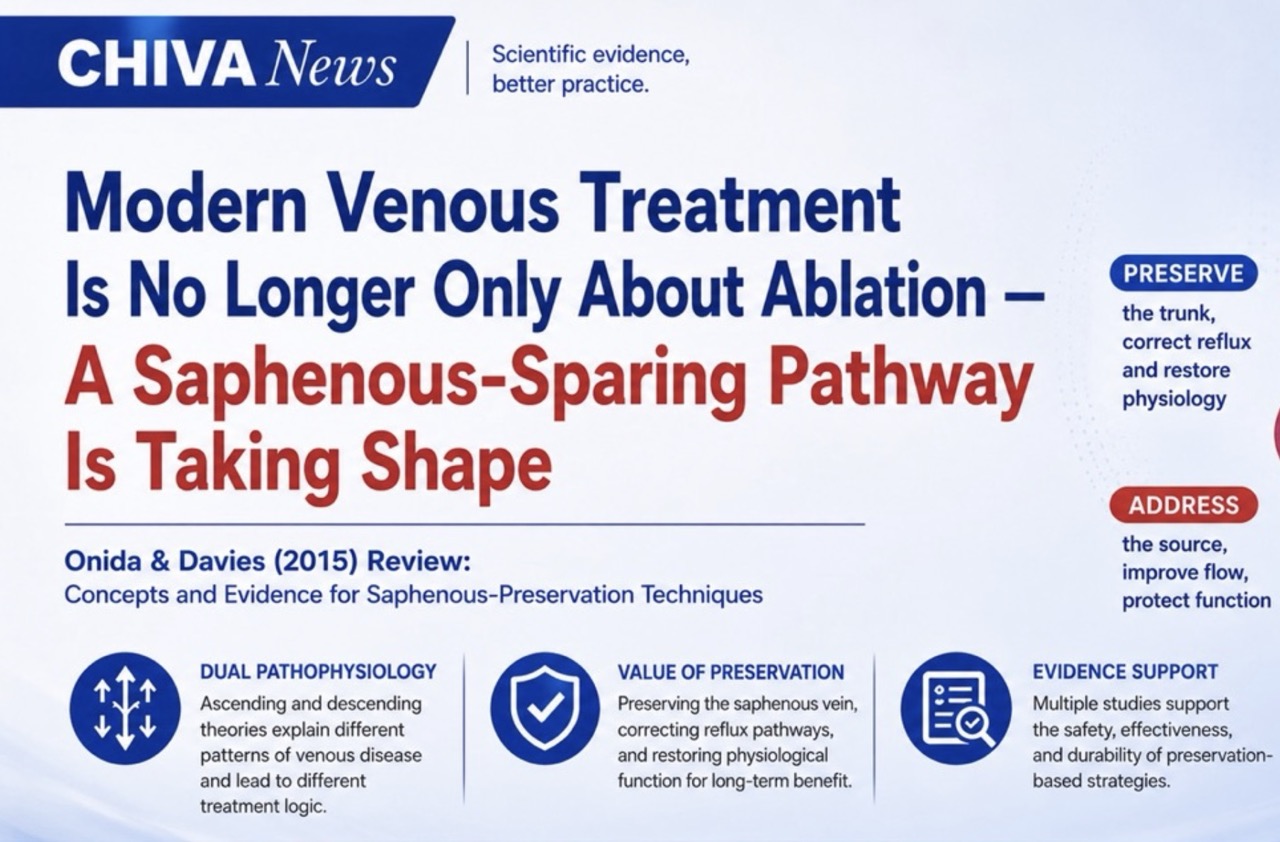
Modern Venous Treatment Is No Longer Only About Ablation — A Saphenous-Sparing Pathway Is Taking Shape
Key Points
Study basis: In 2015, Sarah Onida and Alun H. Davies of Imperial College London published CHIVA, ASVAL and related techniques – Concepts and evidence in a supplement of Phlebology. The review brings CHIVA, ASVAL, and the “ascending” and “descending” theories of venous disease into a single comparative framework.
Core argument: The paper consolidates several saphenous-sparing strategies into what is effectively a treatment pathway parallel to ablation, and observes that advances in imaging and hemodynamic understanding are beginning to challenge the traditional approach of “destroy first, let the system remodel later” at a methodological level.
Clinical implication: Modern venous care should not be reduced to the question of which ablation energy to use. A preservation-based pathway — supported by evidence and grounded in venous hemodynamics — has reached the point of deserving systematic discussion.
When varicose vein treatment is discussed, the conversation tends to move quickly toward a technical comparison: radiofrequency, laser, glue, or some newer energy platform? That trajectory feels natural, because the development of ablation technologies over the past two decades has followed a clear path with easily comparable clinical metrics.
But if the focus shifts back to underlying pathophysiology, a more fundamental question appears: does varicose vein disease spread “downward” from proximal reflux, or accumulate “upward” from the peripheral venous network? The two theories point to different treatment logics. The first supports “eliminate proximal reflux.” The second supports “preserve the trunk, address the periphery.”
Onida and Davies’s 2015 review brings this theoretical divergence and its corresponding clinical strategies into the same frame. The paper does not declare which side is correct. What it does is point to something more important — saphenous-sparing strategies are no longer the marginal choice of a few centers. They have formed a technique family with internal logic and supporting evidence.
1. The Real Contribution: Consolidating Scattered “Preservation Strategies” Into a Pathway
Before 2015, methods such as CHIVA and ASVAL were typically discussed in isolation — each with its own originators, geographies, and naming conventions, and rarely placed in the same context. The significance of this review is that it identifies these methods as belonging to one category — strategies built around the same goal of preserving the vein, grounded in venous hemodynamics.
The clinical value of this consolidation is direct. Before, a physician facing varicose vein treatment options saw mainly a binary choice between “ablation” and “stripping.” What the review surfaces is a third direction that had been under-discussed: preservation-based treatment has acquired enough methodological completeness to stand as an independent pathway.
The framing remains restrained throughout. CHIVA and ASVAL are not singled out for elevation. They are discussed alongside advances in imaging and hemodynamic understanding — placing them in a broader scientific trajectory rather than presenting them as preferred techniques. The implication is that preservation strategies are not a stylistic choice of certain operators, but a direction that emerges naturally once venous pathology is understood with more depth.
2. The Return of the “Ascending” Theory Clarifies the Logic Behind Preservation
The other major thread the paper introduces is the long-running debate about venous pathophysiology.
For decades, the descending theory has dominated clinical decision-making. It holds that varicose disease spreads from a proximal reflux source (such as the saphenofemoral junction) toward the distal network. Under this view, the central treatment task is to eliminate or destroy the proximal reflux pathway. This logic has directly supported the rationale of stripping and ablation.
But advances in imaging and ultrasound have reintroduced the ascending theory into serious discussion. In this view, at least in some cases, varicose disease develops as localized high pressure builds up in the peripheral network and propagates proximally over time. In such cases, the saphenous trunk is not the cause but the conduit.
Onida and Davies note that if the ascending theory holds true in a subset of patients, then automatically ablating the proximal trunk runs into a fundamental problem — what is being destroyed may, in some cases, be a still-functional compensatory channel. CHIVA and ASVAL, by preserving the trunk and focusing on correcting reflux pathways or the peripheral network, are precisely responding to that possibility.
This argument clarifies the foundation of preservation strategies. They are not motivated by opposition to ablation. They are motivated by a more complex understanding of venous pathology.
3. The Way Evidence Is Presented: Cautious, Not Enthusiastic
What is also notable is that Onida and Davies do not advocate strongly for CHIVA or ASVAL. For each technique they list both supporting evidence and current limitations. CHIVA’s evidence base, confirmed by the 2013 Cochrane review, is acknowledged. At the same time, preservation strategies are noted to require higher levels of ultrasound assessment and hemodynamic judgment from the operator — a practical reason for their slower dissemination.
This restrained tone is part of why the paper occupies a distinctive position in the CHIVA literature. It is a neutral synthesis from a third-party academic center, not an internal statement from within the CHIVA system. That position is what allows it to be repeatedly cited in subsequent literature as one of the evidentiary anchors for the legitimacy of preservation strategies.
4. Clinical Perspective: The Decision Space Is Widening — but Decision Criteria Must Become More Refined
Looking only at the list of available techniques, modern venous care does seem to involve more tools — different laser wavelengths, different RF operating temperatures, various adhesive formulations, focused ultrasound, and multiple sub-types within preservation strategies. On the surface, it is a process of “more tools becoming available.”
But what Onida and Davies’s paper points to is a deeper change: what is actually multiplying is not the tools, but the treatment pathways.
Ablation and preservation are not competing camps. They are two clinical strategies based on different pathophysiological interpretations, each with its own appropriate patient populations. This also means that future decision-making will not rest on “which technique is newest,” but on “which pathway better fits this patient’s venous distribution and disease stage.”
This places a higher demand on clinical practice than the technique list itself does. It requires that physicians not only know how to operate each tool, but also recognize when to eliminate, when to preserve, and when to wait. From this perspective, what Onida and Davies are really discussing is not the merits of any single technique. The logic of modern venous care is shifting from “elimination-driven” to “pathway-driven.” That is the deeper reason preservation strategies will need to be discussed more systematically in the years ahead.
Reference
Onida S, Davies AH. CHIVA, ASVAL and related techniques – Concepts and evidence. Phlebology. 2015 Nov;30(2 Suppl):42–45. doi: 10.1177/0268355515591439.
About the Authors
Sarah Onida and Alun H. Davies are based at the Section of Vascular Surgery, Imperial College London, Charing Cross Hospital — one of the leading vascular research teams in the United Kingdom. Professor Davies has long led evidence-based research and systematic reviews in chronic venous disease. The team is not part of the CHIVA system itself, nor does it represent any single technique. This independent academic position is what gives their assessment of saphenous-sparing strategies its distinctive value in the international literature.
Note: This article is based on publicly available literature and is intended for professional information exchange and content research only. It does not constitute specific medical advice.