Moving CHIVA from the Hospital to the Office Is a Methodological Step, Not Just a Change of Setting
Methodological Step, Not Just a Change of Setting
Key Points
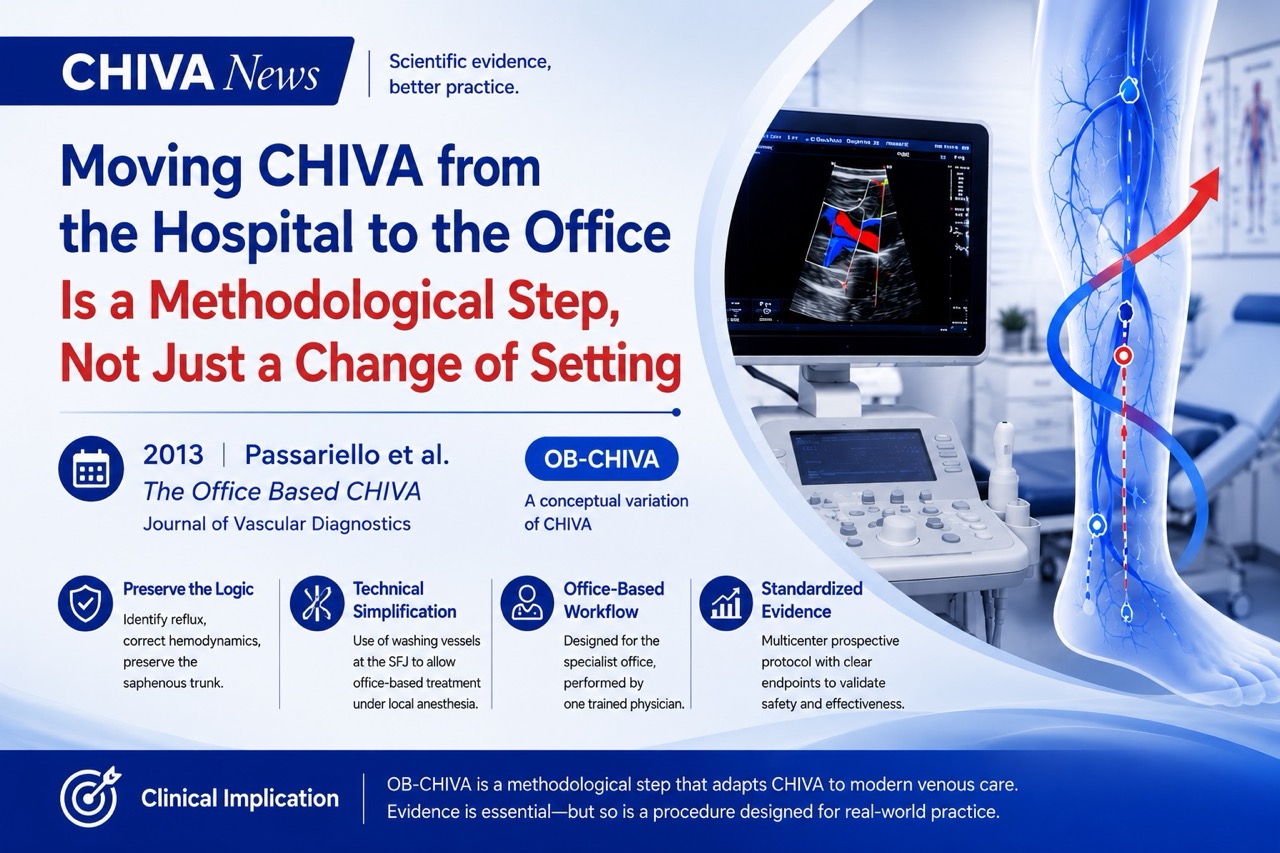
Study basis: In 2013, Passariello and colleagues published The Office Based CHIVA in the Journal of Vascular Diagnostics, co-authored by CHIVA’s founder Claude Franceschi together with key members of the Italian CHIVA school. The paper formally introduced OB-CHIVA (Office-Based CHIVA) as a conceptual variation of CHIVA and proposed a multicenter prospective research protocol.
Core argument: OB-CHIVA is not simply CHIVA performed in a different room. While preserving the full hemodynamic logic of CHIVA, it redesigns key operative steps — including the use of washing vessels at the saphenofemoral junction — so that the entire procedure can be carried out within a specialist office, under local anesthesia, by a single trained physician.
Clinical implication: This concept addresses a long-standing question in CHIVA dissemination — that evidence alone is not enough. For CHIVA to enter broader clinical practice, it must also become compatible, at the procedural level, with the realities of modern venous care.
In the development of varicose vein treatment, “office-based” is often treated as an operational issue — shorter stays, lighter anesthesia, faster turnover. But framing it only as operational misses something more important: office-based delivery places new demands on the method itself.
A treatment cannot be considered office-ready simply because it can be performed outside the operating room. It has to be re-examined and simplified across preoperative assessment, intraoperative steps, and risk control — and the resulting simplification must preserve methodological integrity. Otherwise, what enters the office is not a true office-based procedure, but a hospital procedure performed in an unsuitable environment.
This is exactly the question Passariello and colleagues set out to answer in 2013: how can CHIVA be restructured for the office setting without losing its hemodynamic foundation?
1. OB-CHIVA Is a Concept, Not a New Surgical Technique
The paper makes one distinction very clear: OB-CHIVA is not a “simplified version” of CHIVA, but a conceptual variation of it. That distinction matters.
If OB-CHIVA were just CHIVA with certain steps removed, it would not represent methodological progress — only a compromise. But the authors approach it from the opposite direction. They preserve CHIVA’s core diagnostic logic (identifying reflux, restoring hemodynamics, preserving the saphenous trunk) and redesign the operative components around it so that they fit the office environment.
The implication is that “office-based” is not a question of where the procedure happens. It is a question of how the procedure is designed. OB-CHIVA is not “CHIVA done in an office.” It is “CHIVA designed for the office.”
2. Washing Vessels Are the Key Technical Adjustment
The most important technical modification appears at the saphenofemoral junction (SFJ). In conventional CHIVA, SFJ management involves a relatively complex anatomical exposure and precise dissection of multiple tributaries.
Passariello and colleagues propose using washing vessels to simplify this step — that is, no longer pursuing complete SFJ disconnection, but instead leaving a small SFJ stump and allowing selected tributaries to maintain a local “washing” flow.
This concept was originally used in small saphenous vein (SSV) CHIVA and has since become standard practice in SFJ thermal ablation. The paper systematically applies it to GSV CHIVA, allowing the procedure to be performed in the office under local anesthesia by a single operator.
The authors are also explicit about one point — the use of washing vessels has not yet been validated by reliable comparative research. Tracking this is one of the explicit aims of their multicenter protocol. That willingness to identify and address methodological gaps openly is part of what makes this paper distinctive.
3. The Protocol Reflects a Concern for Standardization
The paper is not a retrospective summary. It is a prospective multicenter research protocol. The aim in 2013 was not to announce that OB-CHIVA had succeeded, but to establish a framework for standardized data collection across centers.
Specific design elements include:
- A simplified diagnostic ultrasound workflow that can be completed within office consultation time
- A standardized operative sequence that allows cross-center data comparability
- Multiple clinical endpoints, including recurrence rate, SFJ stump evolution, the actual function of washing vessels, and saphenous arch recanalization rate
The underlying judgment is direct: for office-based delivery to become a true methodological variant, it must be performable in the same way across different centers. If each center develops its own version of OB-CHIVA, the methodological coherence is lost again.
This is one of the reasons the protocol remains widely cited in the CHIVA literature. It represents not the experience of one center, but an organized attempt at cross-center standardization.
4. Clinical Perspective: Office-Based Is a Methodological Event, Not a Choice of Location
Why does OB-CHIVA deserve to be discussed as an independent concept?
On the surface, it might appear to simply describe “doing the procedure in an office.” But viewed over a longer timeline, it represents a meaningful internal adjustment within the CHIVA system itself — a shift from a precise operation dependent on the OR environment to a process-based treatment compatible with modern specialist care settings.
That shift is not trivial. Each simplification step requires answering two questions: Can this step be omitted? If so, can methodological integrity still be preserved? What makes the Passariello protocol important is that it does not avoid these questions — it places them within a multicenter framework where they can be answered with data.
Looking back today, this direction is consistent with the broader trajectory of CHIVA’s development. Whether through the Global CHIVA Program’s standardization of training, or through the gradual movement of specialist centers toward office-based delivery, the implicit premise is the same — CHIVA must evolve from a refined craft mastered by a few highly skilled operators into a clinical workflow that can be reliably reproduced. OB-CHIVA is one of the earliest methodological signposts of that transition.
Reference
Passariello F, Ermini S, Cappelli M, Delfrate R, Franceschi C. The office based CHIVA. Journal of Vascular Diagnostics. 2013;1:13–20. doi: 10.2147/JVD.S49637
About the Authors
This protocol was led by Dr. Fausto Passariello of Centro Diagnostico Aquarius in Naples, Italy, in collaboration with Claude Franceschi — the founder of CHIVA, based in Paris — and members of the Italian CHIVA school, including Stefano Ermini (Florence), Massimo Cappelli (Florence), and Roberto Delfrate (Cremona). The combination of authors itself carries methodological weight: the paper draws on both the original theoretical lineage of CHIVA and the cross-center clinical experience of Italian specialist centers. In 2009, Passariello and Nick Morrison performed the first OB-CHIVA interventions; this 2013 protocol marked the formal conceptualization of that experience and its move toward cross-center standardization.
Note: This article is based on publicly available literature and is intended for professional information exchange and content research only. It does not constitute specific medical advice.