A Preoperative Flow Signal May Indicate That Some Type III Shunt Patients Can Remain Stable After a Single Step
Key Takeaways
• Study basis: In 2024, Cappelli, Molino Lova, Pinelli, and Franceschi published a study in Veins and Lymphatics exploring whether it is possible to predict before treatment which great saphenous vein type III shunts managed with the CHIVA 2 strategy could remain hemodynamically stable after the first step alone.
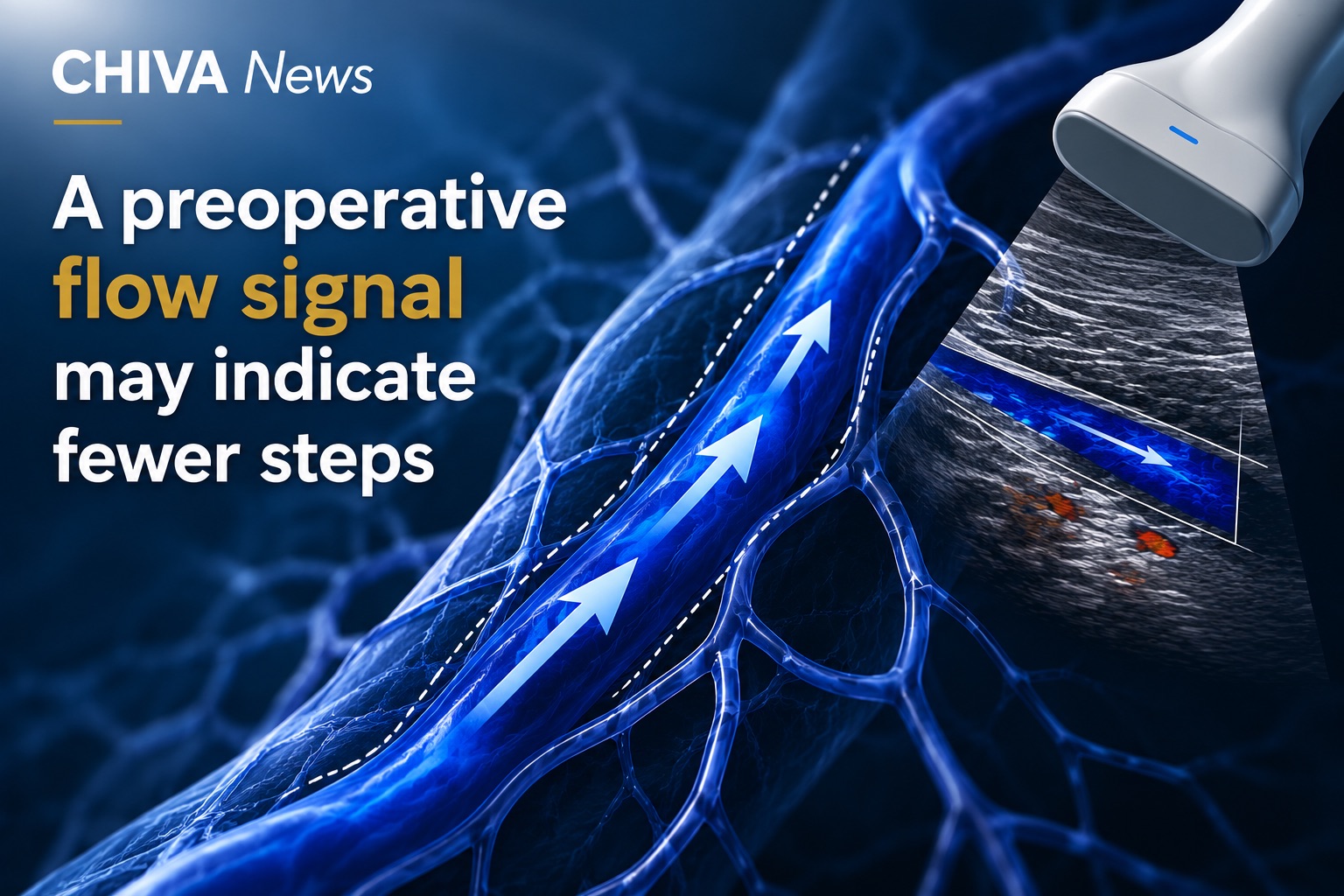
• Core point: Antegrade flow detectable along the full length of the great saphenous vein before treatment was identified as an important factor associated with postoperative stability. In the study cohort, up to approximately 45% of cases may not have required a second procedure.
• Clinical relevance: This finding moves CHIVA 2 beyond a simple “perform the first step and observe” approach, toward a process that may be partly predictable before treatment, while giving some patients the possibility of a simpler course of care.
For type III shunts, CHIVA uses a staged strategy known as CHIVA 2. The first step consists of disconnecting the incompetent tributary. The connection between the great saphenous vein and the deep venous system is not closed at the same time, in order to preserve effective drainage through the trunk and reduce the risk of postoperative thrombophlebitis.
The trade-off is that some patients later redevelop great saphenous vein reflux during follow-up and require a second procedure. A long-standing question has therefore remained: can we identify before treatment which patients may actually need only the first step?
1. What the Study Found
The study examined great saphenous vein type III shunts treated with the first step of CHIVA 2 and looked for preoperative factors associated with subsequent hemodynamic stability.
The results pointed to one clear indicator: antegrade flow detectable along the entire course of the great saphenous vein before treatment.
When this antegrade flow was still present on early examination after the first step, the great saphenous vein was more likely to remain stable without further intervention. In the study cohort, up to approximately 45% of cases may not have required a second step.
The mechanism is relatively straightforward. Antegrade flow suggests that the great saphenous vein still retains an effective drainage pathway. Once the incompetent tributary responsible for the abnormal hemodynamic load is disconnected, the trunk may be able to regain stability without requiring closure of its connection to the deep venous system.
2. Making the Staged Strategy More Predictable
The value of this finding lies in how it changes the decision-making process in CHIVA 2.
Previously, whether a second step would be necessary was answered mainly through follow-up after the first procedure. This study suggests that a preoperative flow feature may help indicate, at least to some extent, whether the first step could be sufficient.
It shifts the staged strategy from passive observation toward a process that may be partly anticipated before treatment.
This may have two consequences. First, it could reduce the treatment burden: some patients with this flow pattern may require only one intervention and avoid a second procedure.
Second, it has broader methodological significance. It again shows that CHIVA reads flow, not anatomy alone. The same hemodynamic reasoning used to explain what happens after treatment may also help estimate in advance how much intervention a particular patient is likely to need.
It should be stated clearly that this was a specialized single-cohort study conducted by researchers from the CHIVA field. Its predictive value still needs to be tested in broader populations and across different centers. Even so, the direction it identifies is specific and clinically relevant.
3. Clinical Perspective: Making Preservation More Precise
One of CHIVA’s defining features is that it targets abnormal flow rather than simply targeting a diseased vein.
This study takes that principle one step further. It suggests that the same interpretation of flow may also help match each patient with a more appropriate degree of intervention.
From this perspective, preservation is moving from a general principle toward a more precise clinical practice. If preoperative predictors of this kind are further validated, CHIVA 2 may become better able to achieve a central aim of the method: using the minimum necessary intervention to support long-term preservation of the great saphenous vein.
⸻
Reference
Cappelli M, Molino Lova R, Pinelli M, Franceschi C. Factors affecting the evolution of type III shunts of the greater saphenous vein after the first step of the CHIVA 2 strategy. Veins and Lymphatics. 2024. Published online November 11, 2024. Available at: pagepressjournals.org/vl/article/view/13043.
About the Authors
This study was conducted by Massimo Cappelli and Raffaele Molino Lova in private practice in Florence, Mauro Pinelli in Avezzano, Italy, and Claude Franceschi at Hôpital Saint Joseph in Paris. It was published in Veins and Lymphatics.
Disclaimer
This article is based on publicly available literature and is intended for professional information exchange and content research. It does not constitute specific diagnostic or treatment advice.