The Real Question About CHIVA Has Shifted — From “Is There Evidence?” to “Can It Be Reproduced?”
Key Takeaways
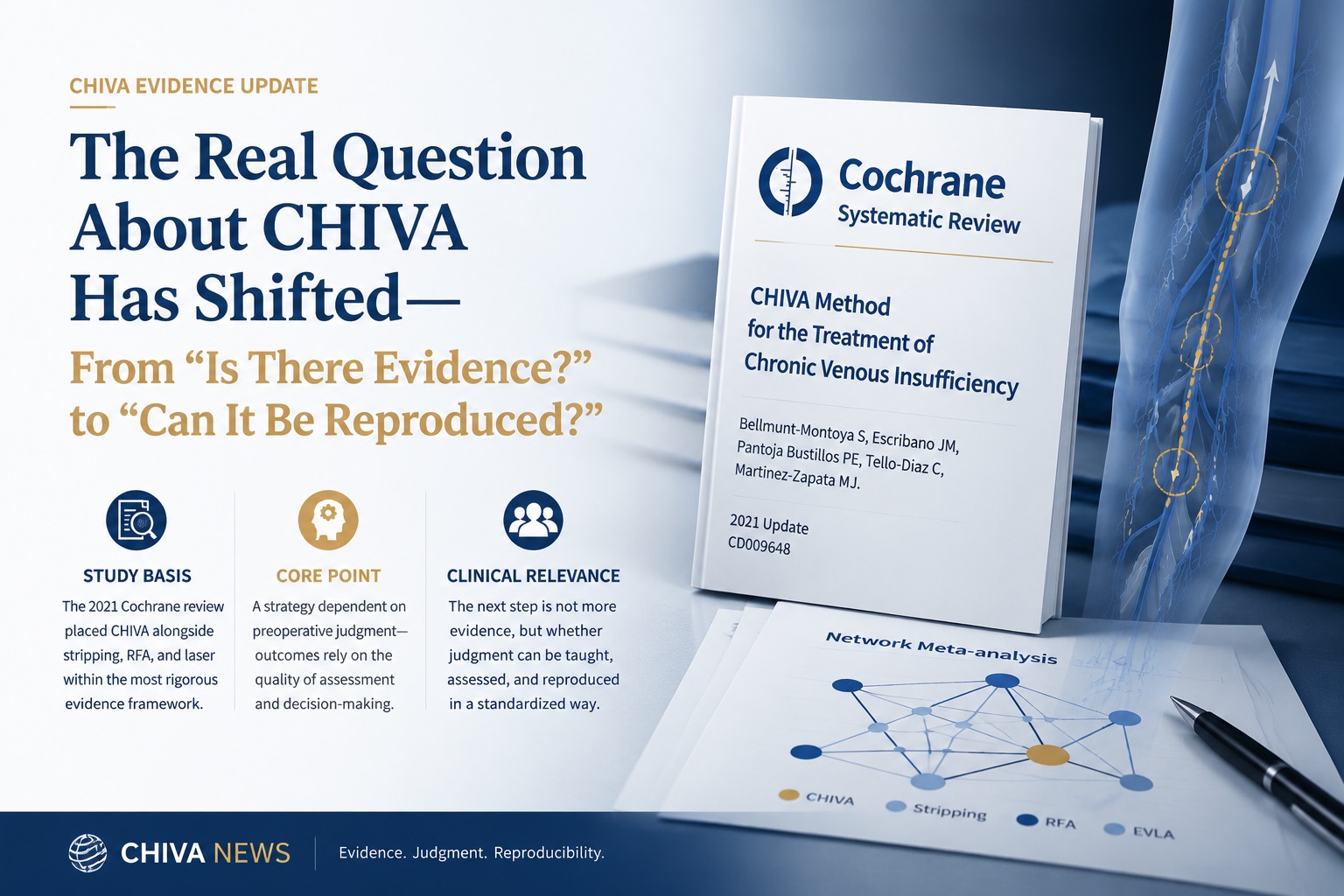
• Study basis: The 2021 update of the Cochrane systematic review (Bellmunt-Montoya et al., CD009648) evaluated CHIVA alongside stripping, radiofrequency, and laser within a single framework — placing CHIVA within the most rigorous tier of evidence-based scrutiny.
• Core point: The review confirms CHIVA’s standing as an evidence-backed strategy, while also exposing why its evidence struggles to reach high certainty: this is a strategy that depends heavily on preoperative judgment, with outcomes resting on the quality of assessment and decision-making rather than on a fixed operative maneuver.
• Clinical relevance: For a method like this, the decisive question for the next stage is no longer the quantity of evidence, but whether the judgment itself can be taught, assessed, and reproduced in a standardized way.
Being included in a Cochrane review is an exacting process for any procedure. Cochrane endorses no technique; it only weighs the quality of the evidence. CHIVA passed through that process — but what it revealed along the way matters more than the passing itself.
1. Entering systematic review confirms CHIVA’s evidentiary standing
CHIVA has long been misread as a niche technique dependent on the experience of a few operators. The reason is understandable: it cannot be reduced to “removing” or “closing” a segment of vein. Its core lies in preoperative ultrasound assessment, reflux-path identification, and shunt classification.
Yet the fact that a method can enter systematic review and be quantitatively compared, head-to-head, with mainstream procedures shows that it has crossed the threshold from craft to a treatment strategy that can be formally tested. This evidentiary standing carries more weight than any single outcome measure.
2. Why the evidence struggles to reach high certainty lies in the method itself
Cochrane’s overall appraisal of CHIVA is cautious: the certainty of evidence for most outcomes was rated low. But the reason behind that rating is more worth reading than the rating itself.
Stripping and ablation involve relatively fixed maneuvers that are easy to standardize, which makes trials naturally comparable. CHIVA is different. Its results depend heavily on what happens before the procedure — whether the mapping is complete, the shunt classification accurate, the drainage pathways worth preserving correctly identified. Two surgeons who both claim to “do CHIVA” may deliver two different treatments. Much of the difficulty in accumulating high-certainty evidence traces back to this.
This is not a flaw in the method, but the transitional cost of a strategy that has not yet been sufficiently standardized.
3. Clinical perspective: after evidence comes reproducibility
The next step for CHIVA, then, is not to keep adding to the literature, but to make the judgment that underpins its results teachable, assessable, and reviewable. Identifying escape points, classifying shunts, distinguishing compensatory pathways from diseased ones — once these can be taught and examined in a structured way, heterogeneity between studies will fall, and the certainty of the evidence will have room to rise.
The standardized training and certification efforts that have emerged around CHIVA in recent years — such as the Global CHIVA Program — point precisely to this layer. What they set out to answer is no longer whether CHIVA works, but how to get the judgment behind its results reliably reproduced by more clinicians.
This is why the review still rewards a second reading: it confirms that CHIVA rests on evidence, and it advances the question one crucial step — from being proven to being accurately performed.
⸻
References:
Bellmunt-Montoya S, Escribano JM, Pantoja Bustillos PE, Tello-Díaz C, Martinez-Zapata MJ. CHIVA method for the treatment of chronic venous insufficiency. Cochrane Database of Systematic Reviews. 2021;9:CD009648. doi:10.1002/14651858.CD009648.pub4. PMID: 34590305.
About the authors:
This Cochrane systematic review was conducted by Sergi Bellmunt-Montoya and colleagues at the Department of Angiology, Vascular and Endovascular Surgery, Hospital Universitari Vall d’Hebron, Universitat Autònoma de Barcelona, together with the Iberoamerican Cochrane Centre (IIB Sant Pau, Barcelona), and published in the Cochrane Database of Systematic Reviews.
Disclaimer:
This article is compiled from publicly available literature for the purpose of professional information exchange and content research. It does not constitute specific diagnostic or treatment advice.
About CHIVA News:
This column is produced by GCM (Global CHIVA Management). We are dedicated to tracking and sharing the latest academic developments, literature analyses, and clinical-practice discussions in the field of hemodynamic treatment of lower-limb venous disease worldwide, providing rigorous and objective medical information for clinical professionals.