CHIVA, Stripping, and Endovenous Ablation: A Comparison of Nerve-Injury Risk
Key Takeaways
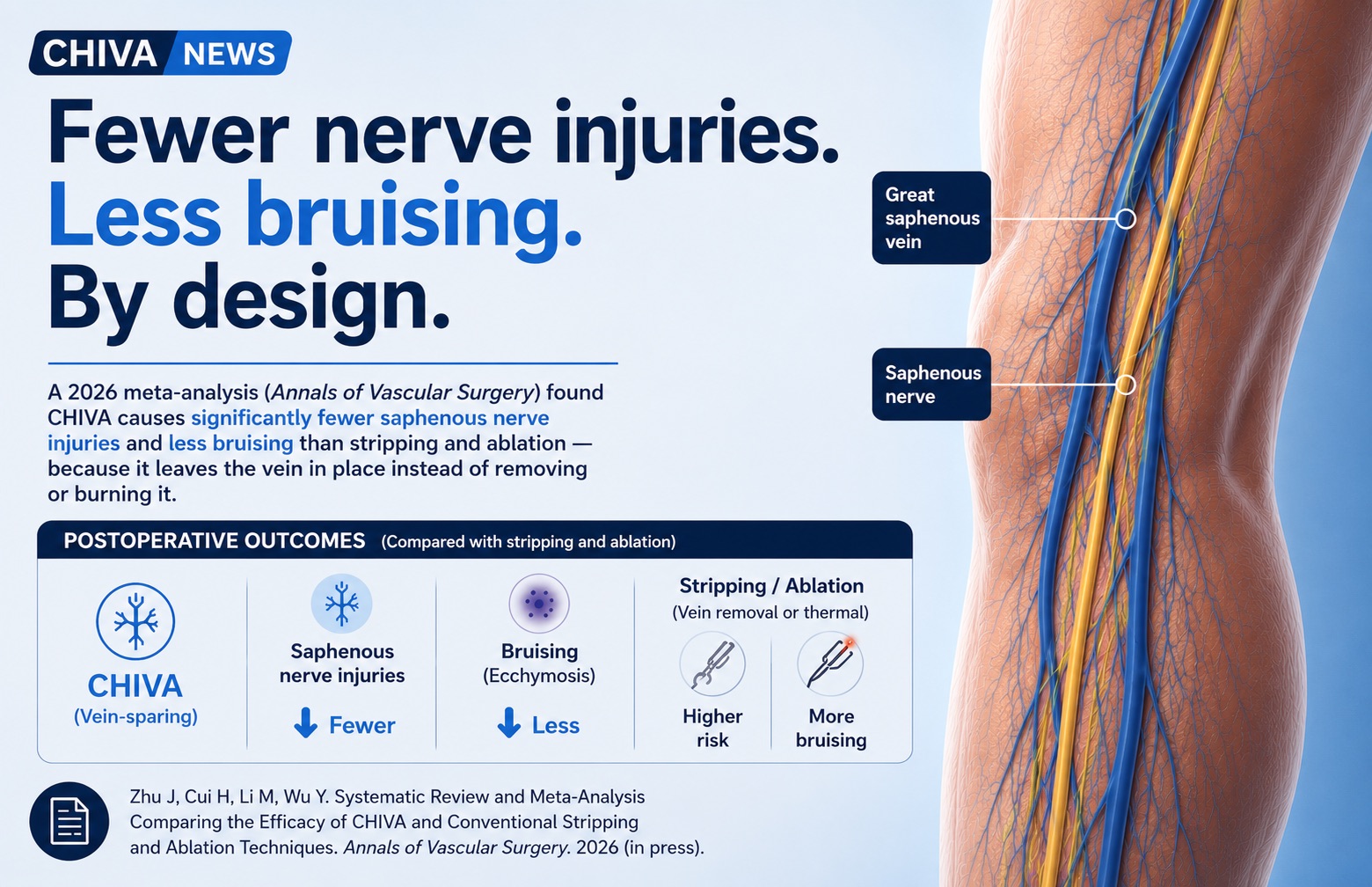
• Study basis: In 2026, Jinghe Zhu and colleagues published a systematic review and meta-analysis in Annals of Vascular Surgery, showing that CHIVA significantly reduces postoperative saphenous nerve injury and bruising compared with conventional high ligation and stripping (HLS) and endovenous ablation.
• Core point: This advantage is not incidental. It follows from anatomy and procedural logic — the saphenous nerve runs immediately alongside the great saphenous vein, so removing or thermally destroying the vein inherently places the nerve at risk, whereas CHIVA leaves the vein in place.
• Clinical relevance: Saphenous nerve injury is a common, and often irreversible, complication of conventional varicose vein treatment that directly affects sensation and quality of life. Avoiding it structurally is a tangible clinical benefit.
When we judge the success of varicose vein treatment, most of the discussion lands on whether the reflux was eliminated and whether the vein was closed. Yet running right beside the great saphenous vein (GSV) is a structure that is easily overlooked: the saphenous nerve. It travels alongside the GSV, and below the knee the two are almost in contact. This sets up a frequently underestimated cost — the way the vein is treated can injure the nerve next to it.
Zhu and colleagues’ 2026 meta-analysis provides pooled evidence that CHIVA causes fewer nerve injuries. What deserves to be spelled out, though, is the reason behind it.
1. Why the saphenous nerve gets injured
The saphenous nerve is a terminal branch of the femoral nerve. It descends along the great saphenous vein and is especially closely related to it in the lower leg. This means that any procedure whose goal is to remove or destroy the GSV struggles to avoid it entirely.
Stripping is the clearest example. When the GSV is avulsed from groin to ankle, the stripper drags on and tears the accompanying nerve branches. Prior literature has estimated the incidence of saphenous nerve injury with full-length stripping to be as high as 20%–40%. Thermal ablation (laser or radiofrequency) works differently: it does not avulse the vessel, but it delivers heat inside the vein lumen, and the adjacent nerve can be burned as a result.
In other words, nerve injury in these procedures is not an “operative error” — it is a structural risk built into the logic of the technique itself.
2. What this meta-analysis found
Zhu and colleagues’ systematic review and meta-analysis pooled multiple controlled studies comparing CHIVA with stripping and CHIVA with ablation. On the safety dimension, CHIVA showed a clear advantage: significantly fewer postoperative saphenous nerve injuries, and a lower incidence of bruising compared with stripping.
It should be stated honestly that this is not a report of CHIVA being superior across the board. For recurrence rate, thrombophlebitis, and wound infection, CHIVA showed no significant difference compared with stripping and ablation — that is, the two approaches are broadly comparable in long-term durability. But this is precisely what gives the nerve-related advantage its weight: the lower rate of nerve injury is not bought at the price of higher recurrence.
The authors also note the limitations of the evidence honestly: the number of included randomized controlled trials is small, head-to-head randomized comparisons with ablation are especially lacking, some studies carry publication bias, and there is apparent heterogeneity between studies. What is emphasized here, therefore, is a conclusion whose direction is clear but which still needs more high-quality research to consolidate.
3. Clinical perspective: avoiding injury by structure, not by technique
The way CHIVA reduces nerve injury is not the same as “operating more carefully.” Its basis is this: because it neither avulses nor burns the great saphenous vein, but instead leaves it in place and corrects the flow, the saphenous nerve traveling alongside the vessel is excluded from the path of traction and heat from the outset. The advantage comes from the structure of the procedure, not from repeated caution on the operator’s part.
For patients, the significance of this is concrete. Saphenous nerve injury can present as numbness or altered sensation from the medial lower leg to the foot, and it is frequently difficult to recover from. Unlike recurrence, which can be treated again, it is often a one-time, long-lasting outcome. For patients who place high value on preserving normal sensation after surgery, this is not a minor technical detail but potentially a decisive factor in their choice.
This is also why evaluating a venous treatment should not ask only how thoroughly it eliminates reflux, but also what additional cost it imposes on the patient to achieve that goal. On this rarely-tabled cost, the vein-sparing approach happens to stand on the safer side.
⸻
References: Zhu J, Cui H, Li M, Wu Y. Systematic Review and Meta-Analysis Comparing the Efficacy of CHIVA and Conventional Stripping and Ablation Techniques. Annals of Vascular Surgery. 2026 (available online 16 February 2026; version of record 8 March 2026). PII: S0890509626000944. https://www.sciencedirect.com/science/article/abs/pii/S0890509626000944
About the authors: This study was conducted by teams from the Department of Vascular Surgery at Beijing Luhe Hospital and Xuanwu Hospital, Capital Medical University, together with the Evidence-Based Medicine Center (corresponding author: Yingfeng Wu), and published in Annals of Vascular Surgery.
Disclaimer: This article is compiled from publicly available literature for the purpose of professional information exchange and content research. It does not constitute specific diagnostic or treatment advice.
About CHIVA News: This column is produced by GCM (Global CHIVA Management). We are dedicated to tracking and sharing the latest academic developments, literature analyses, and clinical-practice discussions in the field of hemodynamic treatment of lower-limb venous disease worldwide, providing rigorous and objective medical information for clinical professionals.