CHIVA Changes More Than Recurrence Rates — It May Also Reshape the Invisible Inflammatory Environment
Key Points
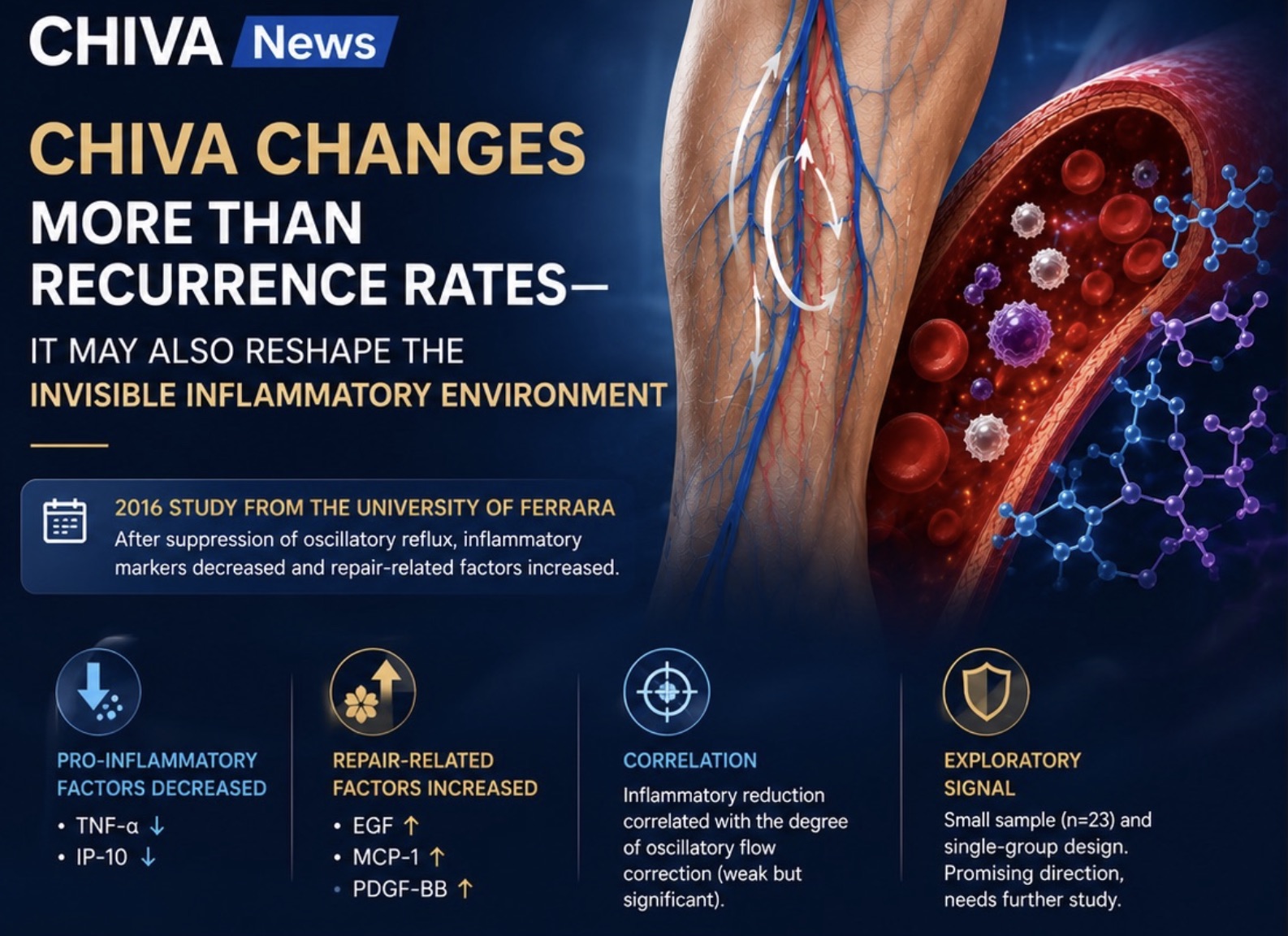
- Study basis: In 2016, Paolo Zamboni, Veronica Tisato, Sergio Gianesini, and colleagues from the University of Ferrara published a study in the Journal of Surgical Research examining how the cytokine profile of patients with chronic venous disease changed after surgery suppressed the “oscillatory component” of venous reflux.
- Core finding: After oscillatory reflux was suppressed, several pro-inflammatory mediators, including TNF-α and IP-10, decreased significantly, with two returning to the physiological range. At the same time, several factors related to tissue repair increased.
- Clinical relevance: This extends the benefit of “correcting flow” beyond visible clinical improvement to the molecular level. But because the sample was small and the correlations were weak, the findings should still be regarded as an early directional signal rather than a definitive conclusion.
When CHIVA is discussed in varicose vein treatment, attention usually remains focused on visible endpoints: recurrence rates, preservation of the great saphenous vein, and reduced procedural trauma.
But if one of the ways venous hypertension and reflux damage tissue is by continuously generating a chronic inflammatory state, then a more fundamental question emerges: when flow is corrected, does the inflammatory environment begin to recede as well?
This is the level at which the 2016 study by Zamboni and colleagues places the question.
1. Background and study design
The pathophysiology of chronic venous disease (CVD) is still not fully understood, but inflammation is increasingly considered to play an important role in its development. Disturbed, oscillatory flow may activate the endothelium, trigger the release of pro-inflammatory mediators, and participate in venous wall remodeling. This has become one of the most widely discussed mechanistic chains in the disease process.
The study team treated patients with reflux using a hemodynamic corrective procedure designed to suppress the “oscillatory component” of reflux, then measured 19 cytokines before and after intervention and compared the results with healthy controls. It should be noted that this strategy of suppressing oscillatory reflux and correcting hemodynamics is precisely grounded in the mechanical principles established by CHIVA, and the authors themselves belong to the Ferrara school within the CHIVA framework. In the end, 23 patients completed follow-up, and ultrasound confirmed that the oscillatory component had indeed been suppressed.
2. Core findings
Among the patients who completed follow-up, 4 of the 19 measured markers showed significant postoperative decreases in pro-inflammatory mediators: tumor necrosis factor-alpha (TNF-α), granulocyte colony-stimulating factor (G-CSF), interferon gamma-induced protein 10 (IP-10), and interleukin-15 (IL-15).
Two of these changes were especially notable because they returned to the physiological range: TNF-α fell from 5.3±2.7 to 4.2±2.2 pg/mL (P<0.003), and IP-10 fell from 303.7±168.4 to 254.0±151.6 pg/mL (P<0.024). More importantly, the decreases in these two markers showed a statistically significant, although weak, correlation with the degree to which oscillatory flow had been corrected — the more completely the oscillatory component was suppressed, the more clearly the inflammatory signal moved downward.
At the same time, 3 mediators related to tissue repair and remodeling increased: epidermal growth factor (EGF), monocyte chemoattractant protein-1 (MCP-1), and platelet-derived growth factor-BB (PDGF-BB). Comparisons with healthy controls further supported the direction of these changes.
In other words, the corrected local environment seemed to shift from a predominantly pro-inflammatory state toward one more oriented to repair.
3. Clinical perspective: what is corrected is not only flow direction, but also the environment driven by abnormal flow
The central proposition of CHIVA has always been: correct the flow, rather than destroy the vein. This study pushes that proposition one layer deeper. What may be corrected is not only the direction and pressure of flow, but also the inflammatory environment continuously driven by abnormal hemodynamics.
If oscillatory flow does in fact promote pro-inflammatory mediator release and venous wall remodeling through endothelial activation, then the observation that pro-inflammatory markers decrease while repair-associated markers rise after suppression of the oscillatory component suggests something important. “Preserving the vein” may no longer mean simply “doing less damage.” It may mean creating a mechanical and biochemical environment in which the venous wall has a chance to repair itself. In that sense, these findings move in the same direction as previous observations of caliber reduction in the great saphenous vein and the common femoral vein after CHIVA.
At the same time, the weight of this study needs to be framed honestly. It was a single-group exploratory design with only 23 patients completing follow-up. Of the 19 markers measured, only 4 changed significantly. The correlations between inflammatory reduction and hemodynamic correction were described by the authors as “weak but significant,” which means the results are directionally consistent but insufficient for strong causal claims. In addition, the study came from a CHIVA-affiliated research center. For all of these reasons, this type of mechanistic study is better understood as a promising signal that deserves further follow-up, rather than as a settled conclusion.
Even so, the judgment it suggests remains valuable: the significance of a venous treatment may not be fully captured by looking only at what it eliminates — visible reflux or visible varicosities. It may also depend on what kind of environment it leaves behind for the venous system. From that perspective, the value of “correcting flow” may be extending from the mechanical level into the level of tissue biology.
⸻
Reference
Zamboni P, Spath P, Tisato V, Tessari M, Dalla Caneva P, Menegatti E, Occhionorelli S, Gianesini S, Secchiero P. Oscillatory flow suppression improves inflammation in chronic venous disease. Journal of Surgical Research. 2016;205(1):238–245. PMID: 27621026.
About the Authors
This study was led by Professor Paolo Zamboni of the Vascular Diseases Center at the University of Ferrara in Italy. The team comes from the Ferrara school, one of the most active academic centers in CHIVA today, combining expertise in hemodynamics and CHIVA methodology (Zamboni, Gianesini) with strengths in translational immunology (Tisato, Secchiero). This is also why the study was able to connect flow correction with changes in inflammatory mediators. Zamboni was also the first author of the landmark 2001 paper on the hemodynamic model, which has previously been discussed in this column.
Note
This article is based on publicly available literature and is intended for professional information exchange and content research only. It does not constitute specific medical advice.
About CHIVA News
This column is planned and produced by GCM (Global CHIVA Management). We are committed to tracking and sharing global academic developments, literature insights, and clinical discussions in the hemodynamic treatment of lower limb venous disease, providing rigorous and objective medical information for professional physicians.