A Direct Comparison with Mainstream Radiofrequency Ablation: Similar Outcomes with CHIVA, and a Shorter Hospital Stay
Key Takeaways
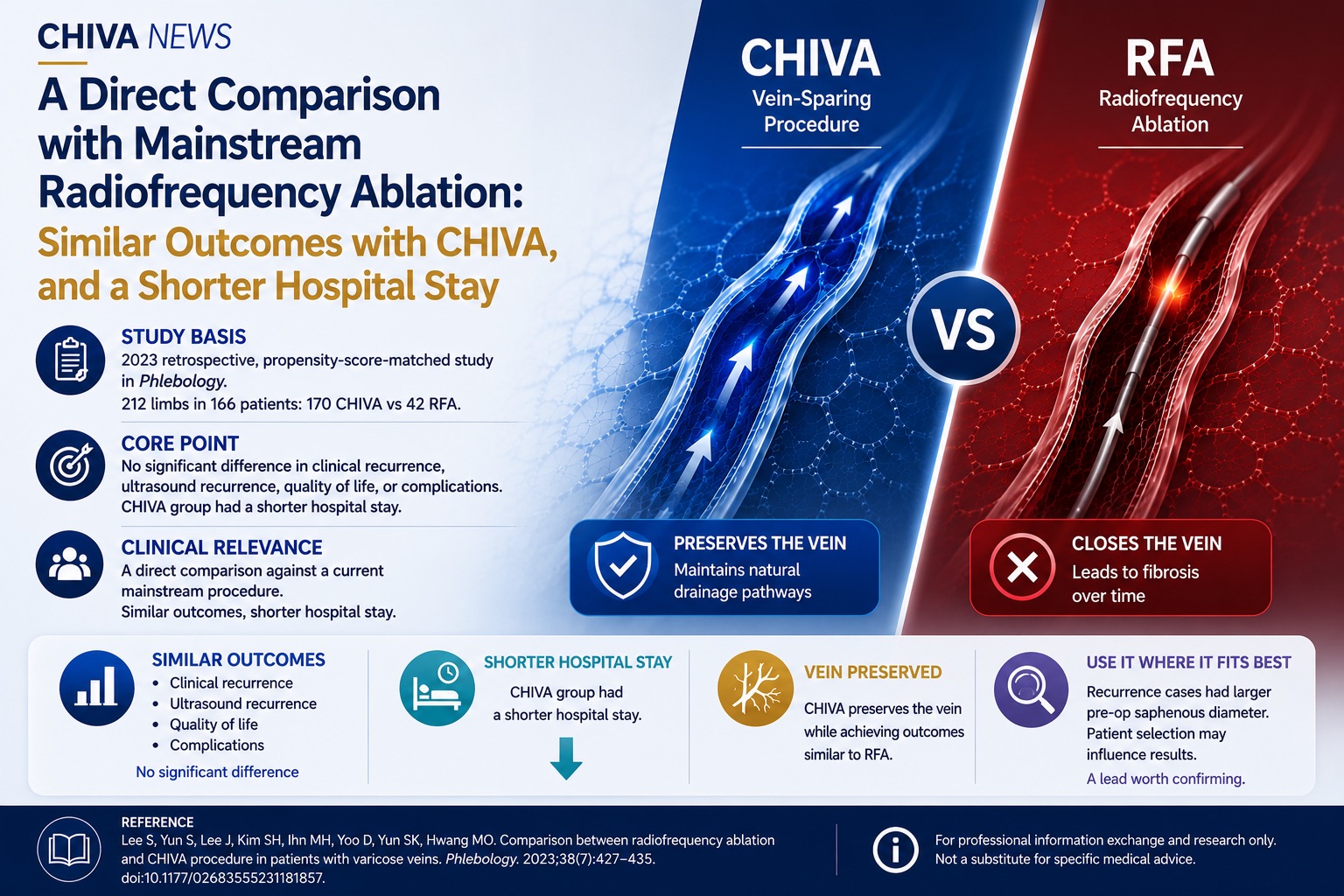
• Study basis: In 2023, Lee et al. published a retrospective, propensity-score-matched study in Phlebology directly comparing CHIVA with radiofrequency ablation (RFA) in the treatment of varicose veins, involving 212 limbs in 166 patients.
• Core point: No significant difference was observed between the two groups in clinical recurrence, ultrasound recurrence, quality of life, or complications, while the CHIVA group had a shorter hospital stay; the authors consider CHIVA, in selected patients, to be a simple and more efficient treatment method.
• Clinical relevance: The study observed no significant difference between CHIVA and RFA in the main clinical outcomes, alongside a shorter hospital stay in the CHIVA group — in a direct comparison against a current mainstream procedure.
To gauge where CHIVA stands today, a more clinically relevant comparator is no longer the stripping that has been in use for over a century, but the endovenous thermal ablation that is now widely adopted. This 2023 study from Korea placed CHIVA directly alongside radiofrequency ablation.
1. What the study found
This is a retrospective study that used propensity-score matching to balance baseline differences between the groups. It included 212 limbs in 166 patients — 170 treated with CHIVA and 42 with RFA — comparing clinical recurrence, ultrasound recurrence, quality-of-life scores, and complications.
No significant difference was observed between the two groups in clinical recurrence, ultrasound recurrence, quality of life, or complications, while the CHIVA group had a shorter hospital stay. The study also noted that the recurrence cases had a larger pre-operative great saphenous vein diameter. On this basis, the authors consider CHIVA to give results comparable to RFA and to be, in selected patients, a simple and more efficient treatment method.
These results, however, come from single-center retrospective data, with only 42 limbs in the RFA arm — a modest sample. And because the study was not an equivalence or non-inferiority trial with a pre-specified margin, “no significant difference observed” means that this study did not detect a difference, not that the two have been proven equivalent in efficacy.
2. Why this direct comparison is more clinically relevant
What matters is the comparator.
RFA is a widely adopted endovenous treatment and one of the mainstream, guideline-recommended procedures. Compared with a comparison against traditional stripping, a direct comparison between CHIVA and RFA is closer to today’s actual clinical choices; with no significant difference observed in recurrence, quality of life, and complications, it carries more direct practical relevance.
Beyond the similar outcomes, the study also recorded one concrete difference: a shorter hospital stay in the CHIVA group. It should be noted that length of stay may also be affected by local care pathways, anesthesia practices, and discharge policies, so this at least suggests lower use of inpatient resources at this center, and may not transfer directly to other health systems. It is also worth noting that CHIVA achieved outcomes similar to ablation while preserving the vein — RFA closes and ultimately fibroses the vein, whereas CHIVA leaves it in place. This can also be read alongside the 2023 systematic review by Zhu et al.: the available comparisons do not show CHIVA trading a higher recurrence risk for vein preservation, while complications such as nerve injury and post-operative bruising may be fewer.
3. Clinical perspective: using it where it fits best
The study’s observation that recurrence cases had a larger pre-operative saphenous diameter suggests that patient selection may influence CHIVA’s results. Rather than a weakness, this outlines a direction worth attention: as a hemodynamics-based strategy, CHIVA is more effective where the anatomy is suitable. That said, this observation is for now only a lead worth confirming, and is not yet sufficient to establish a definite diameter threshold or indication criterion.
Seen this way, the significance of this comparison is clearer: when CHIVA is compared directly with a current mainstream procedure, its practical relevance as a vein-sparing pathway with similar outcomes becomes more evident. And as more such direct comparisons appear, where this pathway best fits within modern venous treatment will gradually come into clearer focus.
⸻
References: Lee S, Yun S, Lee J, Kim SH, Ihn MH, Yoo D, Yun SK, Hwang MO. Comparison between radiofrequency ablation and CHIVA procedure in patients with varicose veins. Phlebology. 2023;38(7):427–435. doi:10.1177/02683555231181857.
About the authors: This study was conducted by Seungjoon Lee, Sangchul Yun, and colleagues at the Department of Surgery, Soonchunhyang University Seoul Hospital, Korea, and published in Phlebology, with Sangchul Yun as corresponding author.
Disclaimer: This article is compiled from publicly available literature for the purpose of professional information exchange and content research. It does not constitute specific diagnostic or treatment advice.
About CHIVA News: This column is produced by GCM (Global CHIVA Management). We are dedicated to tracking and sharing the latest academic developments, literature analyses, and clinical-practice discussions in the field of hemodynamic treatment of lower-limb venous disease worldwide, providing rigorous and objective medical information for clinical professionals.