CHIVA and Postoperative Venous Diameter Changes: A Long-Neglected Insight
Key Takeaways
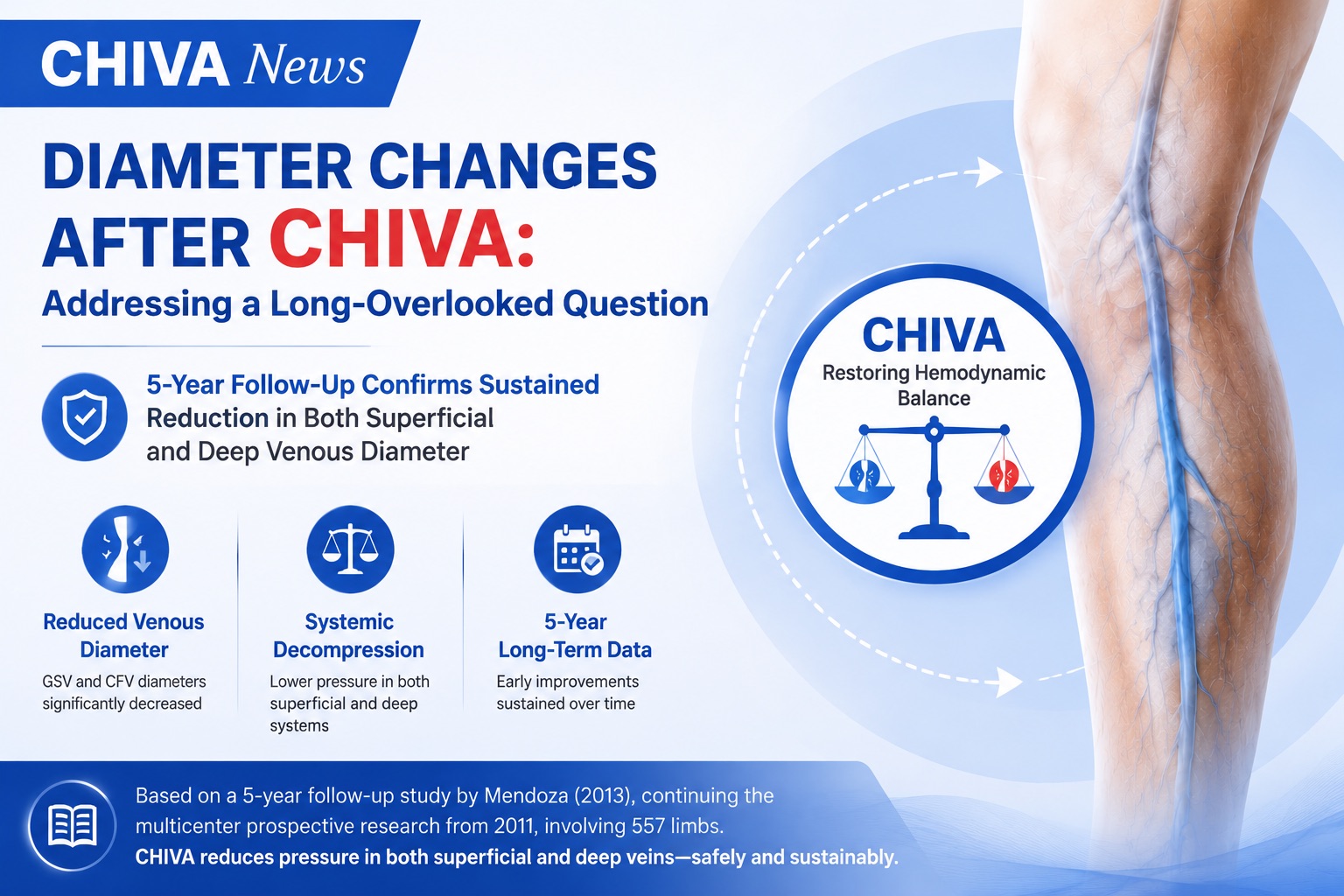
- Study Base: In 2013, Mendoza published a 5-year follow-up study in Phlebologie, extending his 2011 multicenter prospective research, systematically observing changes in the great saphenous vein (GSV) and common femoral vein (CFV) diameters after CHIVA.
- Core Finding: Early postoperative data from 557 limbs showed significant reductions in GSV and CFV diameters. This long-term follow-up examined whether these changes persisted over time.
- Clinical Insight: The reduction in CFV diameter addresses prior concerns about CHIVA potentially overloading the deep venous system—measured data indicate the opposite effect.
1. Study Design: Measuring What Matters
The 2011 multicenter study involved 458 patients (557 limbs) with standardized pre- and postoperative ultrasound measurements. CFV was measured distal to the saphenofemoral junction, and GSV 10–15 cm below the junction. This targeted measurement reflected the effect of CHIVA on proximal deep veins and main superficial trunks.
The 2013 follow-up extended observations to 5 years, addressing whether early diameter changes were compensatory or long-lasting structural modifications.
2. Observed Outcomes
GSV diameters decreased as expected following reflux correction, reflecting pressure reduction and clinical improvement. The noteworthy finding is the CFV diameter decrease—female CFV reduced from 14.0 mm to 13.7 mm, male CFV from 16.5 mm to 16.1 mm, all statistically significant.
This indicates that CHIVA does not shift superficial reflux burden onto the deep venous system but rather achieves systemic pressure reduction across the venous network.
3. Clinical Perspective: System-Level Decompression
CHIVA’s impact extends beyond isolated ligation points. The GSV, while preserved, shrinks in diameter, and the CFV also decreases without direct manipulation, demonstrating a balanced systemic adaptation rather than a localized effect.
This provides a clear, measurable answer to the long-standing question in CHIVA literature: preserving the GSV is beneficial to overall venous drainage, not merely a theoretical advantage.
About the Author
Erika Mendoza is a leading physician in the field of CHIVA for venous disease in Germany. She has long operated an independent venous clinic in Wunstorf, Hanover, and has continuously published CHIVA-related clinical data in journals such as Phlebologie. She is one of the key figures in introducing the CHIVA system into clinical practice in the German-speaking region.
References
- Mendoza E. Diameter reduction of the great saphenous vein and the common femoral vein after CHIVA. Long-term results. Phlebologie. 2013;42:65–69. DOI: 10.12687/phleb2127_2_2013
- Mendoza E, Berger V, Zollmann C, Bomhoff M, Amsler F. Kaliberreduktion der V. saphena magna und der V. femoralis communis nach CHIVA. Phlebologie. 2011;40(2):73–78. DOI: 10.1055/s-0037-1621759
Note: This article is based on publicly available literature for professional information sharing and research purposes. It does not constitute medical advice.