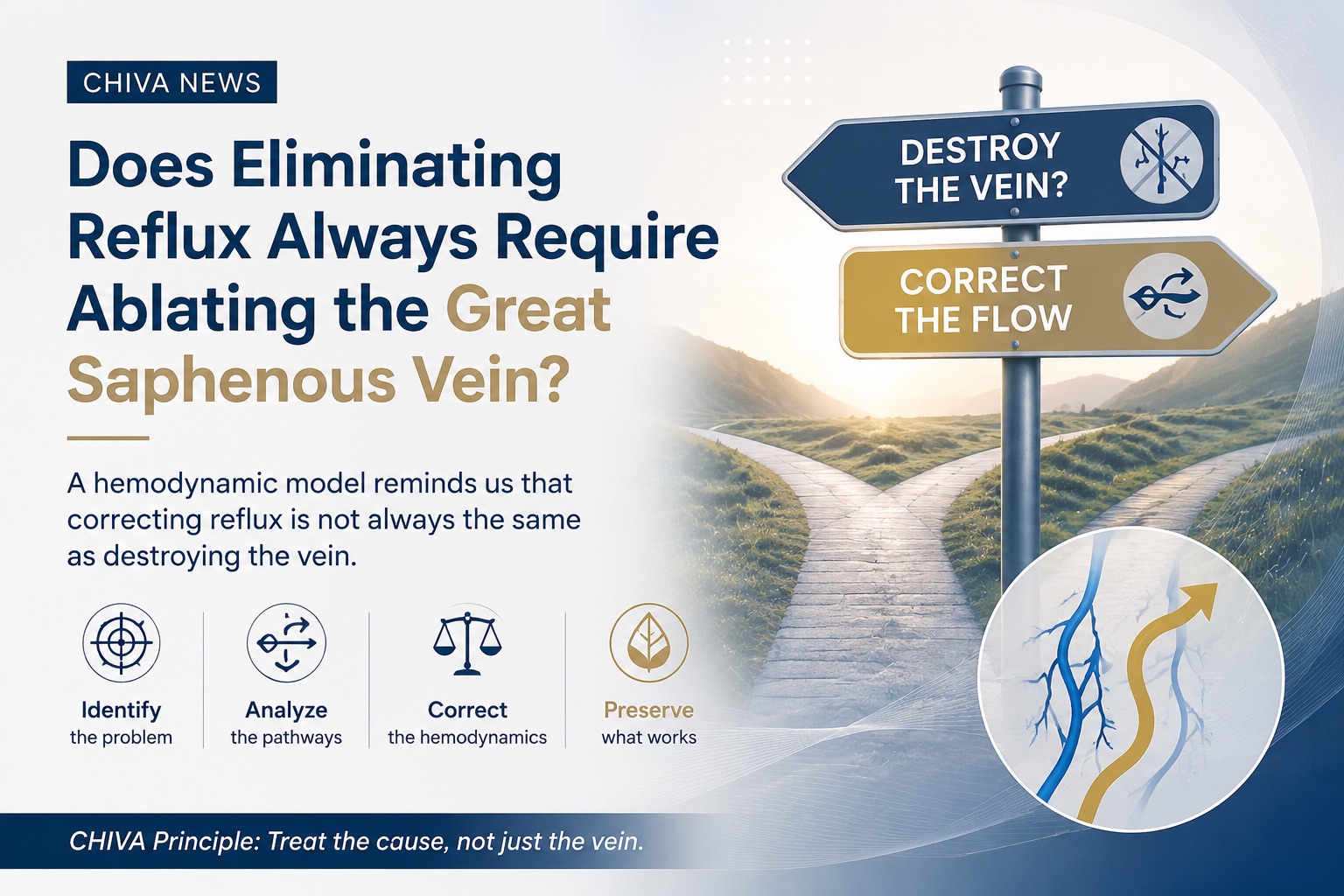
Does Eliminating Reflux Always Require Ablating the Great Saphenous Vein?
Key Points
• Study basis: In 2001, Paolo Zamboni and colleagues published a study in European Journal of Vascular and Endovascular Surgery titled Reflux elimination without any ablation or disconnection of the saphenous vein. A haemodynamic model for venous surgery.
• Core question: The paper did not focus on how to ablate the great saphenous vein more completely. Instead, it asked whether reflux could be eliminated without ablating or disconnecting the saphenous vein.
• Clinical focus: The study proposed that reflux in the great saphenous vein system is supported by the pressure gradient between an anatomic reflux point and a re-entry point. This provides an important model for hemodynamic correction rather than purely anatomic destruction.
In the treatment of varicose veins, one common assumption is easy to understand:
if the great saphenous vein shows reflux, the most direct solution is to close, ablate, or remove it.
This logic appears straightforward.
But it also rests on an important premise: that reflux should be understood mainly as a problem of one diseased vein segment.
The 2001 paper by Zamboni and colleagues approached the question differently.
Rather than asking how to treat the great saphenous vein more aggressively, the authors examined whether reflux in the great saphenous vein system might be maintained by a specific hemodynamic condition, rather than by the vein itself alone.
1. Study Background and Positioning
The title of this paper is already highly direct:
Reflux elimination without any ablation or disconnection of the saphenous vein.
This title captures the key message of the article.
The treatment goal is not framed as “eliminating the great saphenous vein,” but as understanding how reflux is maintained and whether it can be corrected by changing the hemodynamic conditions that support it.
Published in European Journal of Vascular and Endovascular Surgery, the article also carries the subtitle: A haemodynamic model for venous surgery.
This indicates that the authors were not merely describing a technical maneuver, but proposing a model for understanding the relationship between venous reflux and surgical intervention.
That is why the paper remains worth revisiting today.
It shifts the discussion from “whether the great saphenous vein should be removed” to “why reflux occurs, and whether it can be corrected through pressure and flow relationships.”
2. Reflux Is Not Only a Problem of One Vein
The central value of this article lies in its interpretation of great saphenous vein reflux through the lens of pressure gradients.
According to the study, reflux in the great saphenous vein system is supported by the pressure gradient between the anatomic reflux point and the re-entry point.
In other words, reflux is not simply the passive result of one vein segment that has “failed.” It is maintained by a specific hemodynamic condition.
This point is important for how varicose vein treatment is understood.
If reflux is seen only as a problem of one vein, treatment naturally tends to move toward closing or removing that vein.
But if reflux is sustained by pressure gradients and flow pathways, the focus of treatment changes. The physician must identify the true source of abnormal pressure, the point where reflux enters the system, and the pathway through which blood re-enters the deep venous system.
In this view, the goal is no longer simply to remove visible disease.
It is to reorganize pressure and venous return.
3. Reflux Conditions Can Be Changed Without Ablating the Great Saphenous Vein
The most instructive aspect of this paper is that it presents a treatment logic different from main-trunk ablation.
If reflux depends on a specific pressure gradient, then modifying the key conditions that sustain reflux may allow reflux to be eliminated without ablating or disconnecting the great saphenous vein.
This is precisely what the phrase “without any ablation or disconnection of the saphenous vein” emphasizes.
This does not mean that every patient can be treated without intervention on the great saphenous vein.
Nor does it mean that all reflux can be corrected with one uniform method.
The real message is more precise: great saphenous vein reflux should not automatically be equated with the need to destroy the great saphenous vein.
Within a hemodynamic treatment logic, preservation does not mean doing nothing.
Rather, preservation depends on first identifying the abnormal pressure relationships and then using targeted intervention to remove the conditions that maintain reflux.
From this perspective, the article has direct relevance to the CHIVA approach.
CHIVA emphasizes understanding the pressure structure and venous return pathways behind reflux before deciding how to intervene in the most targeted and tissue-preserving way.
4. From Destroying the Vein to Correcting the Flow
The value of this article is not limited to a specific model.
It also changes the way venous reflux is understood.
Conventional treatment often focuses on the vessel itself.
If reflux is seen, the refluxing vein is treated.
If dilatation is seen, the dilated trunk is removed or closed.
This article reminds us that the venous system is not a collection of isolated tubes.
It is a dynamic system shaped by pressure, shunting, reflux, and re-entry pathways.
If treatment focuses only on anatomic appearance, it may overlook why blood is flowing in an abnormal direction.
If treatment returns to hemodynamic relationships, it may become possible to correct abnormal reflux while preserving structures that still have functional value.
This is why the idea that “eliminating reflux does not necessarily mean ablating the great saphenous vein” remains important.
It moves varicose vein treatment beyond the simple removal of a vessel and toward a fuller understanding of the system.
For CHIVA, this is central.
The treatment target is not an isolated vein, but a hemodynamic problem formed by pressure, reflux, and venous drainage.
⸻
Reference:
Zamboni P, Cisno C, Marchetti F, Quaglio D, Mazza P, Liboni A.
Reflux elimination without any ablation or disconnection of the saphenous vein. A haemodynamic model for venous surgery.
European Journal of Vascular and Endovascular Surgery. 2001;21(4):361–369.
doi:10.1053/ejvs.2001.1338.
Note:
This article is based on publicly available literature and is intended for professional communication and content reference only. It does not constitute specific medical advice.