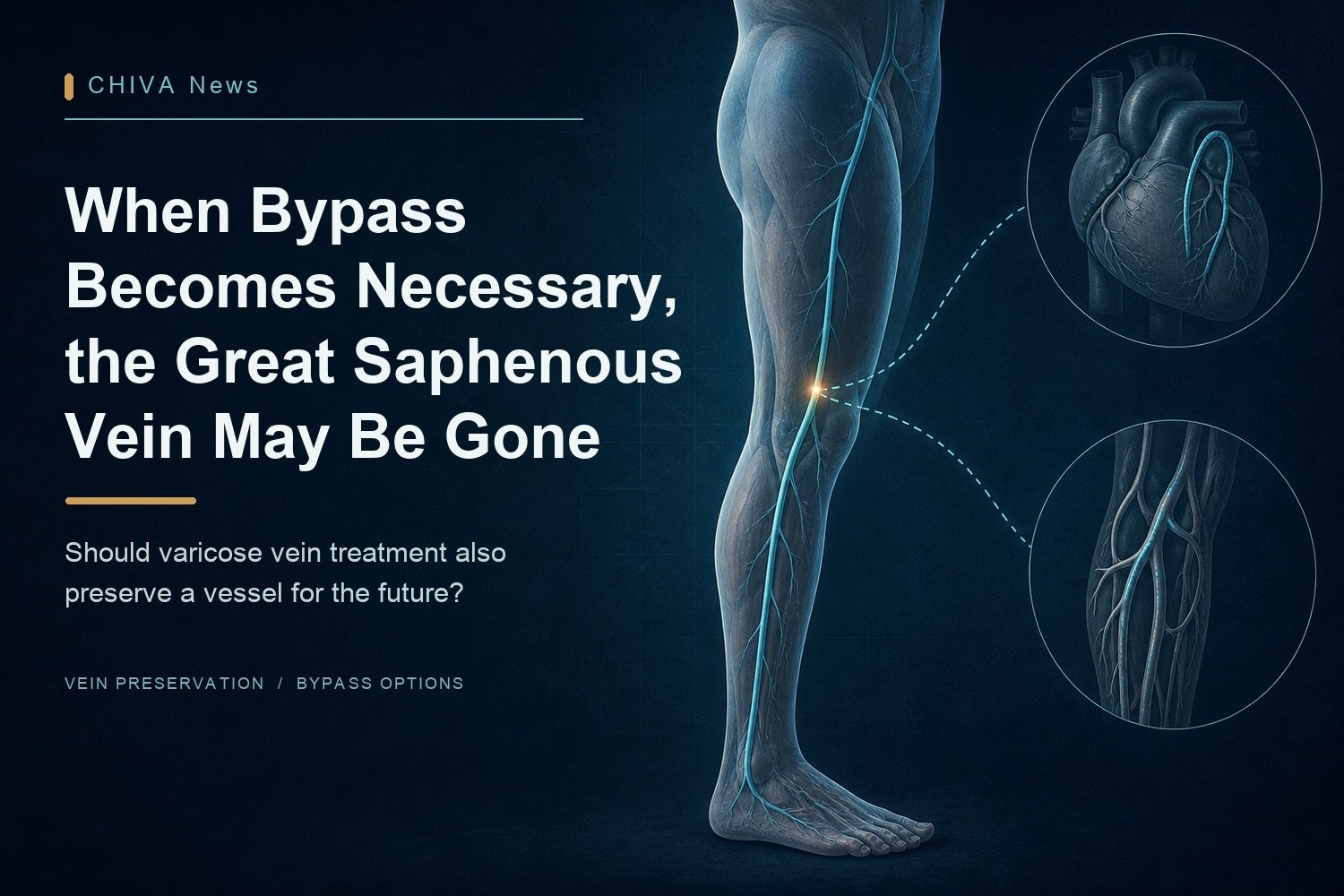
Discovered Only When a Bypass Is Needed: In One of Every Five Limbs with Varicose Veins, the Great Saphenous Vein Has Already Been Ablated
Key Takeaways
In 2024, a team at Pirogov Russian National Research Medical University in Moscow published a single-centre cross-sectional study in the Journal of Clinical Medicine, consecutively enrolling 285 patients with lower extremity arterial disease and performing detailed venous duplex ultrasound on 222 limbs in 111 of them, to assess whether the ipsilateral great saphenous vein (GSV) remained usable as a conduit for arterial bypass.
Among the 51 limbs with varicose veins, 42 GSVs were no longer suitable as bypass material — 82.6%. Of these, 11 had previously undergone GSV ablation, accounting for 21.6% of all limbs with varicose veins.
On this basis, the authors propose that vein-sparing approaches such as CHIVA and ASVAL warrant renewed consideration in the treatment of varicose veins, since they address the present disease while potentially preserving an autologous conduit the patient may need in the future.
1. When it is needed, the vein may no longer be there
The autologous great saphenous vein is an important graft material for lower extremity arterial bypass, particularly in below-knee reconstruction. The difficulty is that by the time a patient actually needs a bypass, the vein may no longer be usable.
The study enrolled 285 patients with symptomatic lower extremity arterial disease, mean age 70.5 years. Of these, 62 had varicose veins or had previously been treated for them.
The team then performed ultrasound assessment on 222 limbs in 111 patients, judging whether the GSV met the basic criteria for use as graft material — diameter, varicose change, and post-thrombotic change.
Among the 171 limbs without varicose veins, 34 GSVs were unusable (19.9%). Among the 51 limbs with varicose veins, 42 were unusable (82.6%). The odds ratio between the two was 18.8.
2. Not all of the unavailability is due to the disease itself
Among the 51 limbs with varicose veins:
- 24 were unsuitable as grafts because of dilatation or varicose change;
- 11 had been permanently lost to previous GSV ablation;
- 6 had post-thrombotic changes.
In other words, in roughly one of every five limbs with varicose veins, the great saphenous vein was lost through the choice of treatment rather than through the disease itself.
The study also records a 65-year-old man whose GSVs had both undergone endovenous laser ablation ten years earlier. When he required coronary artery bypass grafting five years ago, the saphenous vein was no longer available and the radial artery was used instead; when he later faced revascularisation for bilateral lower limb arterial occlusion, neither leg had a usable saphenous vein left.
A single case cannot stand for all patients, but it illustrates a long-running problem plainly: the outcome of one venous treatment may, years later, constrain the treatment options for a different disease.
3. Why the authors return to CHIVA and ASVAL
The authors note that venous ablation procedures have grown rapidly over the past two decades, and that patients treated for varicose veins tend to be some twenty years younger than those with lower extremity arterial disease.
This means that the many patients who have undergone GSV ablation in recent years may not yet have reached the age at which arterial disease and the need for bypass surgery become common. The long-term consequences of removing a vein today may only become apparent many years later.
The authors therefore propose that hemodynamic vein-sparing methods such as CHIVA and ASVAL deserve more serious evaluation. What characterises these approaches is not simply “leaving a diseased vein in place,” but correcting abnormal flow and relieving symptoms while avoiding unnecessary destruction of the saphenous trunk.
Even if vein-sparing methods and ablation prove comparable in long-term clinical outcomes, preserving the great saphenous vein may still carry an additional value: retaining autologous graft material for future coronary or lower limb arterial bypass.
4. Clinical perspective: one treatment, two timescales
This study does not demonstrate that every refluxing great saphenous vein should be preserved, nor does it argue against ablation. Severe varicosity, post-thrombotic change, and other clinical circumstances may still make a GSV impossible to preserve, or unsuitable as graft material.
The question it genuinely raises is this: before deciding to ablate a great saphenous vein, should the probability that the patient will one day need an autologous conduit also enter the present treatment decision?
The hemodynamic assessment and individualised planning that CHIVA emphasises offer one way of approaching that question: the goal of treatment is not only to eliminate the visible reflux or varicosity of today, but also to judge which veins truly must be destroyed, and which may still be preserved once the abnormal flow is corrected.
In treating a varicose vein, the clinician is in fact working across two timescales: the patient’s symptoms today, and the vascular reserve that patient may need years from now.
This study is a reminder that the second timescale should not be left out.
⸻
References: Golovina V, Panfilov V, Seliverstov E, Erechkanova D, Zolotukhin I. Availability of the Great Saphenous Veins as Conduits for Arterial Bypass Surgery in Patients with Varicose Veins. Journal of Clinical Medicine. 2024;13(24):7747. doi:10.3390/jcm13247747.
About the authors: This study was conducted by a team from the Department of Fundamental and Applied Research in Vascular Surgery, Pirogov Russian National Research Medical University, and Pirogov City Clinical Hospital No. 1, Moscow, Russia, and published in the Journal of Clinical Medicine.
Disclaimer: This article is compiled from publicly available literature for the purpose of professional information exchange and content research. It does not constitute specific diagnostic or treatment advice.
About CHIVA News: This column is produced by GCM (Global CHIVA Management). We are dedicated to tracking and sharing the latest academic developments, literature analyses, and clinical-practice discussions in the field of hemodynamic treatment of lower-limb venous disease worldwide, providing rigorous and objective medical information for clinical professionals.