Treat the Tributaries First, Leave the Trunk Alone: Nearly Three-Quarters of Patients Needed No Further Treatment Within a Year
Key Takeaways
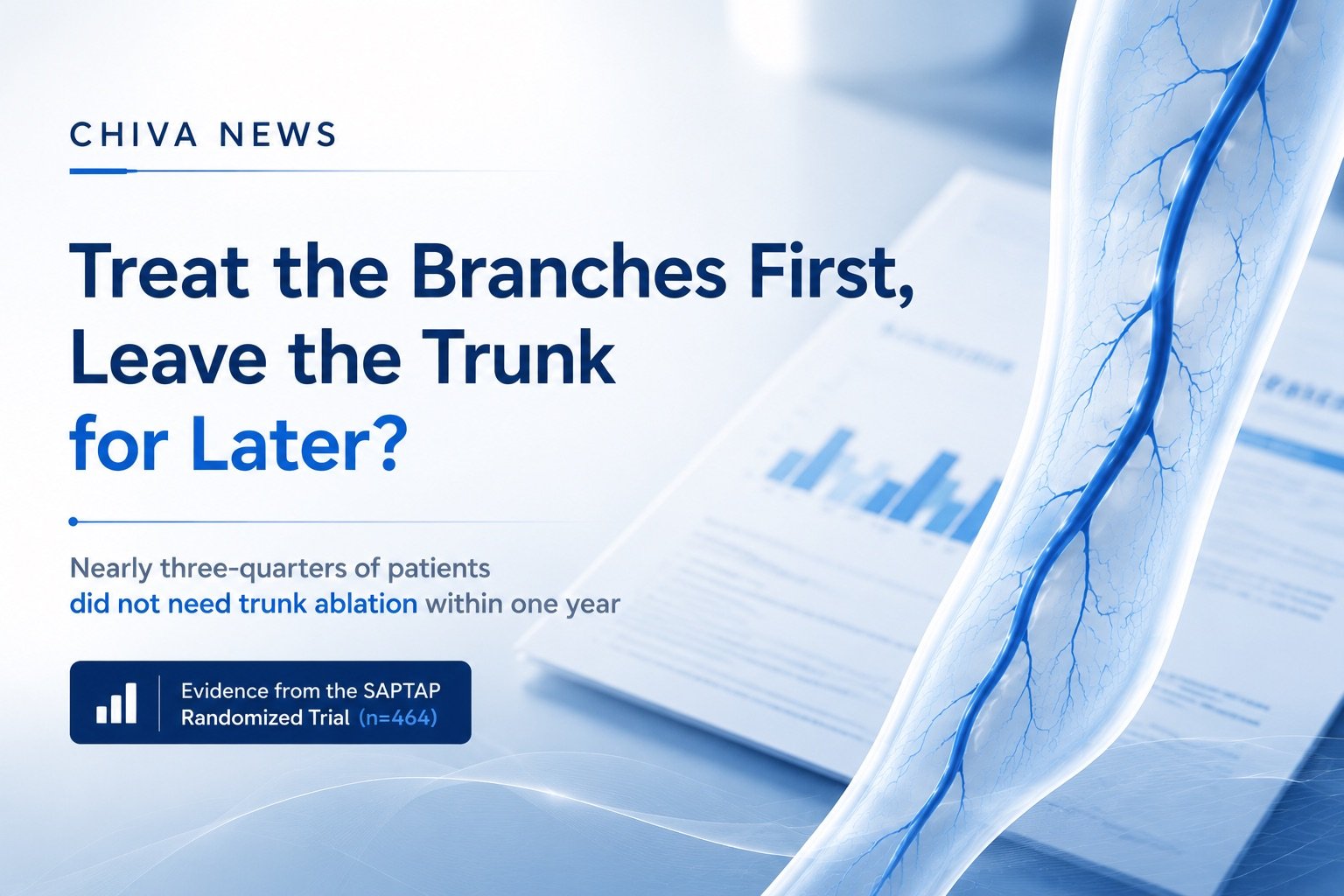
The SAPTAP trial, published in the British Journal of Surgery in 2023, is a multicenter randomized controlled study conducted across seven medical centers in the Netherlands. It enrolled 464 patients with symptomatic saphenous trunk incompetence and concomitant varicose tributaries, comparing two sequences of treatment:
One group underwent excision of the varicose tributaries first, with delayed trunk ablation considered only if symptoms persisted; the other underwent thermal ablation of the trunk together with tributary excision in a single session.
At one year, health-related quality of life in the tributaries-first group was non-inferior to that of the concomitant trunk-ablation group, at lower cost. Only 25.6% of that group went on to require trunk ablation — meaning nearly three-quarters of patients never needed the trunk treated within the first year.
What SAPTAP changes is the sequence
In the conventional pathway, once ultrasound reveals reflux in the saphenous trunk, ablating the trunk is generally treated as the first step. SAPTAP offers an alternative:
Treat first what is most directly visible as varicosity — the tributaries — and leave the trunk under observation; add trunk treatment only where symptoms have not improved sufficiently.
This does not mean trunk ablation lacks value. About a quarter of patients in the trial did eventually require it. But for the remaining three-quarters, ablating the trunk did not become a necessary step, at least within the first year.
What this trial really contributes, then, is not the substitution of one procedure for another, but the conversion of a treatment once completed in a single session into a staged decision: treat, observe, and escalate if needed.
How does it relate to CHIVA?
The isolated tributary excision in SAPTAP is not CHIVA, and it does not employ the hemodynamic mapping, shunt classification, or individualized strategic planning that CHIVA requires.
But it shares an important vein-sparing premise with CHIVA: finding reflux in the trunk does not mean the trunk must be ablated straight away. Whether the trunk needs to be treated, and when, should be judged in light of the patient’s symptoms, hemodynamic characteristics, and the actual changes observed after treatment.
SAPTAP demonstrates, by way of a randomized controlled trial, that in appropriately selected patients, preserving the trunk first and treating it later where necessary can yield short-term quality-of-life outcomes non-inferior to immediate ablation.
It also moves the clinical question one step forward — from “which method should be used to ablate the trunk” to: does this trunk in fact need to be ablated now?
⸻
References: Scheerders ERY, et al. A randomized clinical trial of isolated ambulatory phlebectomy versus saphenous thermal ablation with concomitant phlebectomy (SAPTAP Trial). British Journal of Surgery. 2023;110(3):333–342. PMID: 36464887.
About the authors: This study was conducted by researchers across seven medical centers in the Netherlands, with Eveline R.Y. Scheerders as first author, and published in the British Journal of Surgery.
Disclaimer: This article is compiled from publicly available literature for the purpose of professional information exchange and content research. It does not constitute specific diagnostic or treatment advice.
About CHIVA News: This column is produced by GCM (Global CHIVA Management). We are dedicated to tracking and sharing the latest academic developments, literature analyses, and clinical-practice discussions in the field of hemodynamic treatment of lower-limb venous disease worldwide, providing rigorous and objective medical information for clinical professionals.