3-Year Ulcer Recurrence: 9% vs. 38%:A Randomized Comparison of Hemodynamic Correction and Compression in Venous Ulcers
Key Takeaways
Study background:
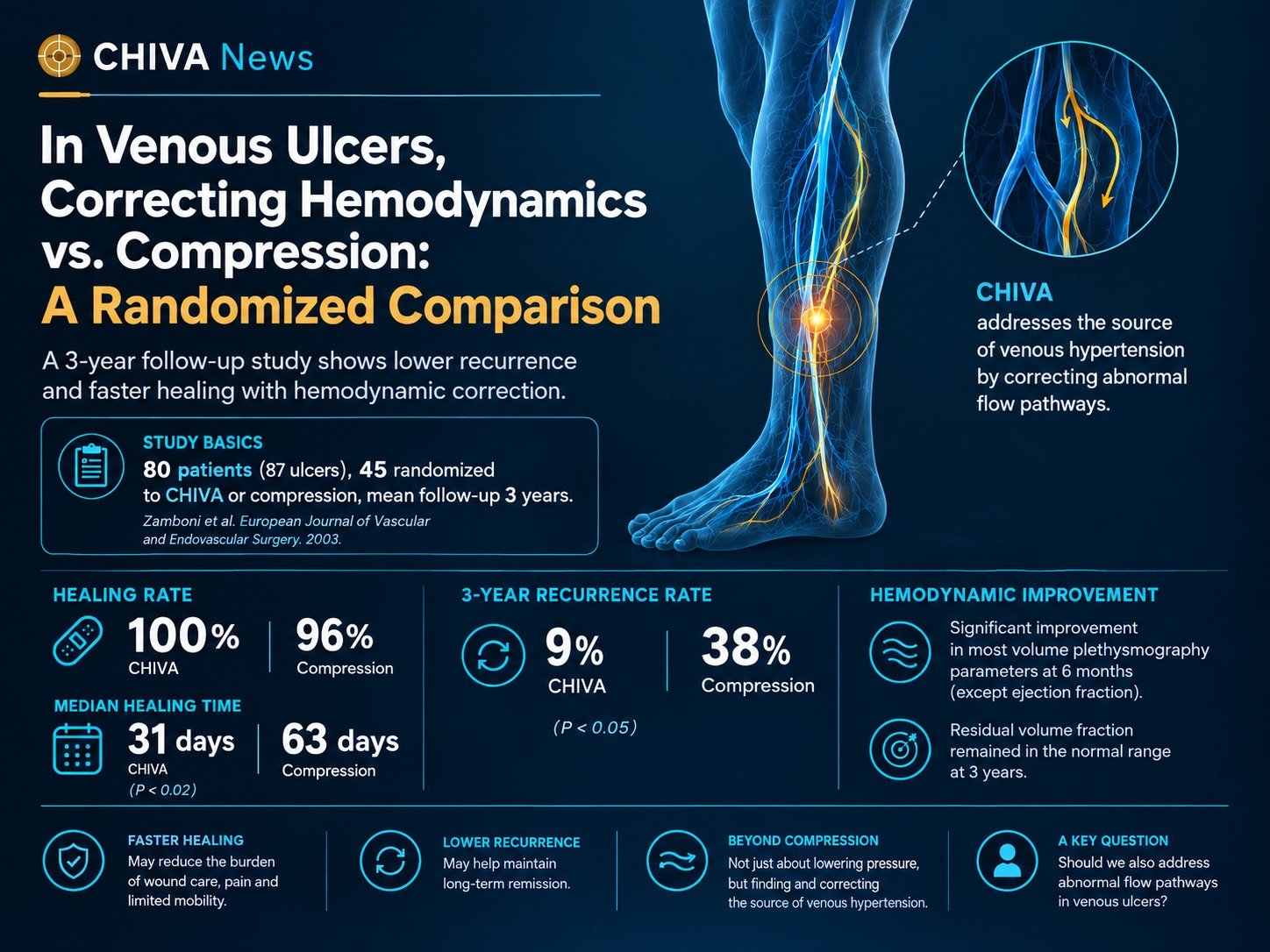
In 2003, Zamboni and colleagues from the Day Surgery Unit at the University of Ferrara, Italy, published a prospective randomized clinical trial in the European Journal of Vascular and Endovascular Surgery. From an initial cohort of 80 patients with 87 venous leg ulcers, 45 eligible patients with 47 ulcers were randomized to either CHIVA-based hemodynamic correction or compression treatment, with a mean follow-up of three years.
Key findings:
The surgical group achieved a 100% healing rate, with a median healing time of 31 days, compared with a 96% healing rate and a median healing time of 63 days in the compression group (P<0.02). At three years, ulcer recurrence was 9% in the surgical group versus 38% in the compression group (P<0.05).
Clinical perspective:
At the more severe end of chronic venous disease, correcting the abnormal hemodynamic pathway was associated with a median healing time approximately half that observed with compression treatment and with substantially lower ulcer recurrence at three years.
Venous leg ulceration represents one of the most severe manifestations of chronic venous disease.
Compression has long been a cornerstone of treatment and is effective in promoting ulcer healing. This randomized trial, however, asked a different question:
Beyond wound care and compression, would correcting the abnormal superficial venous reflux responsible for venous hypertension change the outcome?
1. Trial Design and Clinical Outcomes
The study used a prospective randomized design.
From an initial cohort of 80 patients with 87 venous leg ulcers, 45 eligible patients with 47 ulcers entered randomization and received either CHIVA-based hemodynamic correction or compression treatment. Mean follow-up was three years.
Two clinical outcomes are particularly relevant.
Healing:
All ulcers in the surgical group healed, compared with 96% in the compression group. Median healing time was 31 days with surgery and 63 days with compression (P<0.02).
Both groups therefore achieved high overall healing rates. The more striking difference was the time required to reach healing.
For patients living with venous ulcers, this difference is clinically meaningful. Every additional week with an open ulcer can mean continued wound care, pain, exudation, reduced mobility and impaired quality of life.
Recurrence:
At three years, ulcer recurrence was 9% in the surgical group compared with 38% in the compression group (P<0.05).
Healing and recurrence answer two different clinical questions.
Healing time tells us how quickly the current ulcer closes. Recurrence tells us whether the patient is likely to return to the same condition after healing has been achieved.
2. Hemodynamic Parameters Changed as Well
The investigators did not assess clinical outcomes alone. They also evaluated changes using venous plethysmography.
At six months after surgery, all plethysmographic parameters except ejection fraction had improved significantly.
More importantly, at three years, residual volume fraction remained within the normal range.
This provides an important physiological context for the clinical findings.
The improvement observed in ulcer healing was accompanied by measurable changes in venous hemodynamics. At least part of that improvement remained detectable years after treatment.
In other words, the study was not simply observing short-term wound closure. It was also documenting a change in the way the limb drained venous blood.
This reflects one of the central principles of CHIVA:
the objective is not simply to eliminate a vein, but to correct the abnormal flow relationships responsible for venous hypertension.
The evidence should nevertheless be interpreted within its limitations.
This was a single-center trial published in 2003, with only 45 randomized patients and 47 ulcers. Surgical and compression treatment could not be blinded.
The comparator was compression treatment rather than another surgical or endovenous intervention.
The study therefore addresses the question of whether correcting abnormal venous hemodynamics can provide additional benefit compared with compression-based management. It does not establish superiority over other venous procedures.
3. Placing the Trial in the CHIVA Evidence Base
This study occupies an interesting position in the CHIVA literature.
Much of the discussion around vein-preserving strategies focuses on patients with less advanced chronic venous disease, where outcomes such as symptoms, cosmetic improvement and recurrence are commonly evaluated.
Venous ulceration represents a different clinical endpoint.
Here, the questions are more fundamental:
Will the wound heal? How quickly? And once healed, how long will remission last?
This randomized trial suggests that hemodynamic correction can also translate into measurable clinical benefit at this more advanced stage of venous disease.
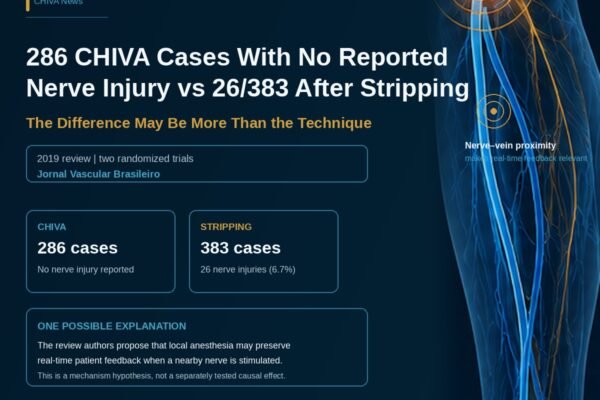
Faccini and colleagues later included the study in their review of CHIVA for chronic venous disease, with venous ulcer recurrence forming an important part of the clinical evidence considered.
The findings therefore suggest that vein-preserving hemodynamic strategies have not been investigated only in early-stage disease; they have also been evaluated in patients with advanced manifestations such as venous ulceration.
For patients with venous ulcers associated with superficial venous reflux, the question raised by this study remains clinically relevant:
Beyond controlling venous hypertension, should we also identify and address the abnormal flow pathways that generate it?
References
Zamboni P, Cisno C, Marchetti F, Mazza P, Fogato L, Carandina S, De Palma M, Liboni A. Minimally invasive surgical management of primary venous ulcers vs. compression treatment: a randomized clinical trial. European Journal of Vascular and Endovascular Surgery. 2003;25(4):313–318. doi:10.1053/ejvs.2002.1871.
Faccini FP, Ermini S, Franceschi C. CHIVA to treat saphenous vein insufficiency in chronic venous disease: characteristics and results. Jornal Vascular Brasileiro. 2019;18:e20180099.
About CHIVA News
CHIVA News is produced by GCM (Global CHIVA Management), tracking research, clinical evidence and international developments in hemodynamic treatment for chronic venous disease.