286 CHIVA Procedures with No Reported Nerve Injury, 26 of 383 After Stripping: The Difference May Not Lie in the Technique Alone
Key Takeaways
• Background: In 2019, Faccini of Brazil, Ermini of Italy, and Franceschi of France published a review in the Jornal Vascular Brasileiro, setting out the technical characteristics and clinical results of CHIVA.
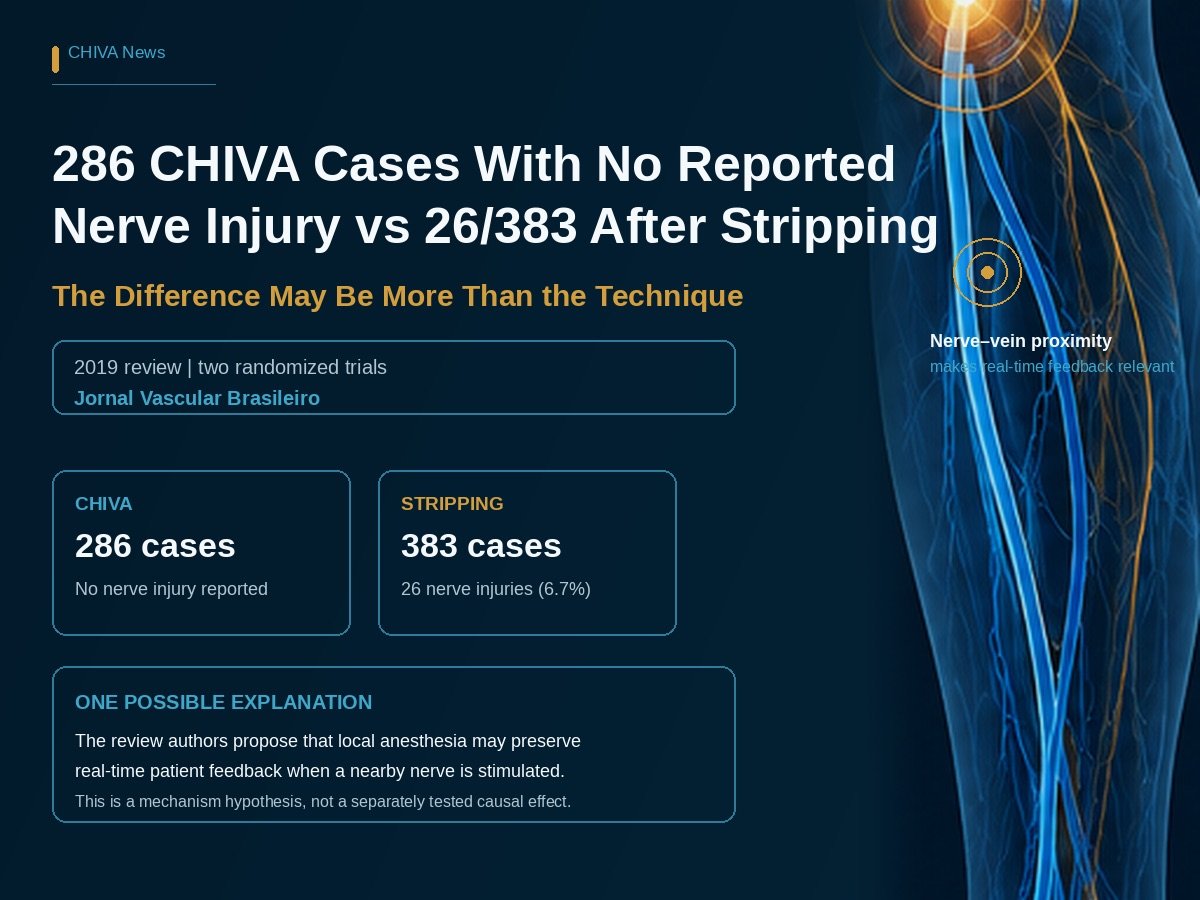
• Key data: Across the two randomized controlled trials cited in the review, no nerve injury was reported among a combined 286 patients treated with CHIVA, while 26 of 383 patients who underwent stripping sustained nerve injury — a rate of 6.7%.
• The authors’ explanation: Beyond the fact that CHIVA neither strips nor thermally ablates the great saphenous vein, the authors raise another reason that may be easily overlooked: CHIVA is typically performed under local anaesthesia, so the patient can alert the surgeon the moment a nerve is stimulated.
That CHIVA is associated with less nerve injury is already supported by existing evidence.
The difference is usually explained first by the procedures themselves — CHIVA does not avulse the vein, nor does it close it with thermal energy, and so avoids the corresponding mechanical traction or thermal injury.
But this review raises a further dimension worth noting: the difference in nerve injury may also relate to the mode of anaesthesia, and to whether the patient’s immediate feedback is preserved during the procedure.
1. Local anaesthesia keeps a “nerve feedback channel” open
The saphenous and sural nerves lie in close anatomical relation to the superficial veins. During venous treatment, whether abnormal stimulation can be detected in time carries practical significance when the operation approaches these nerves.
The authors note that CHIVA is typically performed under local anaesthesia, with the patient awake. When the operation touches the saphenous or sural nerve, the patient can feel it at once and tell the surgeon.
On this basis, the authors argue, the surgeon is given a real-time safety signal, allowing the operation to be stopped or adjusted immediately.
Under general or neuraxial anaesthesia, or where local sensation is fully blocked, this immediate patient-supplied nerve feedback may not exist.
The authors therefore consider that preserving nerve-stimulation feedback under local anaesthesia may be one of the reasons CHIVA is associated with less nerve injury.
It should be emphasised that this is a mechanistic explanation. The two randomized trials compared the overall results of CHIVA and stripping; they did not separately randomize different modes of anaesthesia, and so cannot establish that “local anaesthesia itself reduces nerve injury.”
2. 286 and 383: the difference across two randomized trials
The review cites two randomized controlled trials comparing CHIVA with stripping. Taken together: among 286 CHIVA patients, no nerve injury was reported; among 383 stripping patients, 26 sustained nerve injury, or 6.7%.
What these figures establish, first of all, is that in these two randomized trials, nerve injury observed in the CHIVA group was markedly less frequent than in the stripping group.
As to why that difference arose, there may be more than one reason. CHIVA avoids the mechanical traction produced by stripping the vein, and does not rely on thermal energy to destroy it; at the same time, local anaesthesia allows the patient to retain sensation during the procedure and provide feedback in real time. The authors consider that these factors may have worked together.
Rather than reading these results simply as “CHIVA does not injure nerves,” the more accurate understanding is this: in the existing randomized trials, CHIVA showed a lower risk of nerve injury, and the reasons behind it may lie in both the procedure itself and the state of anaesthesia.
3. Why nerve injury deserves separate discussion
Nerve injury is not merely a technical complication metric.
The review also cites a study of medical litigation in the United Kingdom. The authors note that nerve injury accounted for a considerable proportion of successful claims relating to varicose vein surgery, and that such claims, once upheld, may carry substantial compensation costs.
This means that the value of “one fewer nerve injury” is reflected not only in the patient’s post-operative altered sensation, pain, or quality of life, but extends to the surgeon’s long-term professional risk.
Legal systems and compensation environments differ considerably between countries, of course, so these British figures cannot be extrapolated directly elsewhere.
Still, this perspective offers a reminder: the significance of treatment safety does not end with whether a serious complication occurred by the close of the operation. Nerve injuries that appear not to threaten life, yet may affect how a patient feels for years, equally deserve to be weighed in evaluating a treatment.
From “avoiding injury” to “letting the patient take part in the safety feedback”
The most interesting thing in this review is not that it once again documents a difference in nerve injury between CHIVA and stripping.
What is genuinely worth noting is the explanation the authors offer: CHIVA’s advantage in nerve protection may come not only from “not avulsing the vein” and “not using thermal energy,” but also from something very simple — that during the procedure the patient can still feel, and can tell the surgeon what is happening.
This immediate feedback cannot by itself account for the whole difference in nerve injury, and it has not been independently validated by randomized trials.
But it reminds us that in evaluating a venous treatment, beyond asking what was done, one might ask further: in what state was the treatment carried out? Can the patient’s own sensation also form part of the surgical safety system?
⸻
References: Faccini FP, Ermini S, Franceschi C. CHIVA to treat saphenous vein insufficiency in chronic venous disease: characteristics and results. Jornal Vascular Brasileiro. 2019;18. doi:10.1590/1677-5449.009918.
About the authors: This review was written by Felipe Puricelli Faccini of Hospital Moinhos de Vento and Instituto de Cardiologia, Porto Alegre, Brazil; Stefano Ermini of Italy; and Claude Franceschi of Paris, France, and published in the Jornal Vascular Brasileiro.
Disclaimer: This article is compiled from publicly available literature for the purpose of professional information exchange and content research. It does not constitute specific diagnostic or treatment advice.
About CHIVA News: This column is produced by GCM (Global CHIVA Management). We are dedicated to tracking and sharing the latest academic developments, literature analyses, and clinical-practice discussions in the field of hemodynamic treatment of lower-limb venous disease worldwide, providing rigorous and objective medical information for clinical professionals.