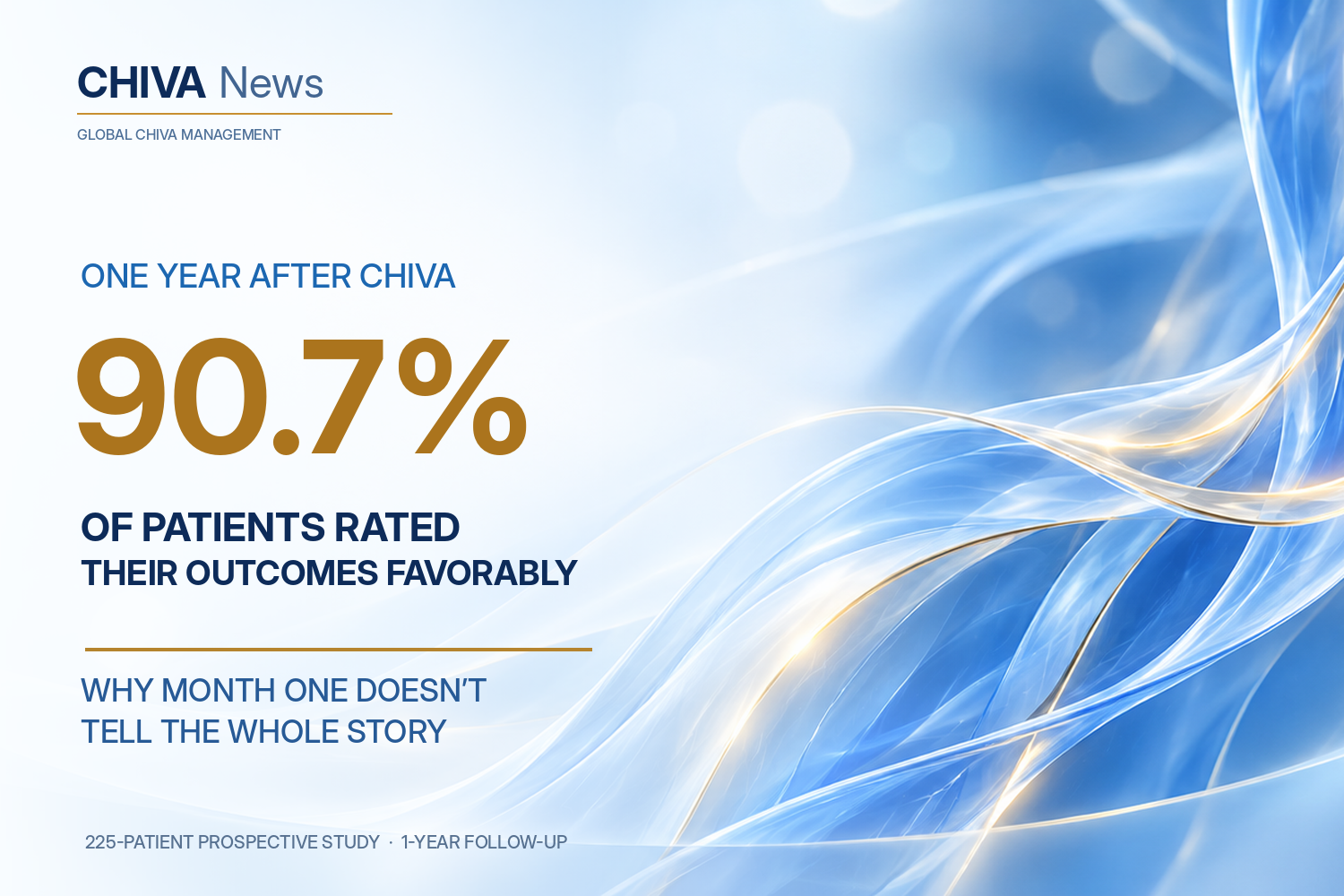
One Year After CHIVA, 90.7% of Patients Rated Their Outcomes Favorably: Why the First Month Isn’t the Whole Story
Key Takeaways
Study Overview: In 2004, a team from Clínica Platón in Barcelona, Spain, published a prospective study in Angiología. A total of 225 patients with primary varicose veins underwent CHIVA treatment. Clinical outcomes were assessed at one month and one year, with a follow-up duplex ultrasound examination at one year.
Key Findings: At one year, favorable outcomes were reported in 87.6% of physician assessments and 90.7% of patient self-assessments. Mean great saphenous vein (GSV) diameter decreased from 6.4 mm to 4.0 mm. Importantly, some patients whose early outcomes were rated poorly showed favorable results at the one-year assessment.
Clinical Implications: Hemodynamic changes and venous remodeling following CHIVA may continue over several months. Early clinical findings do not necessarily represent the full course of postoperative improvement. Appropriate follow-up is therefore essential for evaluating treatment outcomes.
CHIVA aims to improve venous hemodynamics by correcting abnormal reflux and pressure relationships while preserving veins that can contribute to effective drainage.
But the completion of surgery does not necessarily mark the end of the hemodynamic adjustment process.
After abnormal pressure and shunt conditions are modified, preserved veins may continue adapting to their new hemodynamic environment.
In 2004, researchers in Barcelona prospectively followed 225 patients treated with CHIVA for one year.
They observed an important finding: some patients with less favorable clinical assessments at one month showed better results at one year.
What might explain this change?
1. A 225-Patient Study: Clinical Outcomes Can Change Over Time
The study included 225 patients treated for primary varicose veins between October 2000 and June 2001. Of these, 147 were women, the mean age was 48.8 years, and most patients were classified as CEAP C2.
All procedures were performed in an outpatient setting under local anesthesia. A single-stage CHIVA strategy was used in 97.8% of cases.
Clinical assessments were conducted at one month and one year. They included physician evaluations of residual varicose veins and patients’ own assessments of symptoms and cosmetic outcomes.
At one year, 87.6% of physician assessments and 90.7% of patient self-assessments were favorable.
The changes between the two assessments were particularly interesting.
Of 26 patients rated as having poor outcomes by physicians at one month, seven were rated as having good outcomes at one year.
Similarly, among 22 patients who rated their own outcomes poorly at one month, eight reported good outcomes at one year.
These observations suggest that for some patients, clinical improvement may continue to emerge after the early postoperative period.
They do not mean that outcomes improved for every patient or that the overall favorable-outcome rate necessarily increased over time.
2. Behind the Clinical Changes, the Veins Were Also Remodeling
Duplex ultrasound at one year revealed another important finding:
Mean GSV diameter had decreased from 6.4 mm before treatment to 4.0 mm at one year (P=0.001).
Although CHIVA generally seeks to preserve the saphenous trunk rather than remove or occlude it, preservation does not mean that the vein remains in its original pathological state.
As abnormal hemodynamic conditions are modified, the retained venous system may undergo substantial remodeling.
The study also examined postoperative drainage pathways.
At one year, 60.4% of patients demonstrated drainage through re-entry perforators, while a further 12.9% exhibited combined drainage through neo-R3 pathways and perforators.
Drainage through re-entry perforators was associated with more favorable physician and patient assessments at one year (P=0.012 and P=0.017, respectively).
This finding is consistent with the CHIVA principle of preserving effective venous drainage pathways.
However, the observed association does not establish that a particular drainage pattern directly caused better clinical outcomes.
Regarding complications, five patients had symptomatic GSV phlebitis at one month. At one year, thrombus remained detectable in only one patient.
3. Clinical Perspective: When Should CHIVA Outcomes Be Evaluated?
This study raises an important clinical question:
How much time should be allowed for the venous network to adapt after hemodynamic intervention?
CHIVA is not simply intended to eliminate visible varicose veins. Its strategy is based on correcting abnormal shunt and pressure conditions while maintaining effective venous return.
The surgical intervention may be completed in a short period, but remodeling of the preserved veins may take longer.
The authors suggested that some improvements observed between one month and one year could be related to this remodeling process. They also emphasized the importance of allowing for changes over the first several postoperative months when evaluating outcomes.
This does not mean that early postoperative assessment should be postponed or that complications should simply be observed without intervention.
Early follow-up is essential for monitoring recovery, identifying complications, and recognizing problems that may require further treatment. Assessment of sustained clinical benefit, however, should also consider subsequent clinical and ultrasound findings.
The study had important limitations. It was a prospective study without a concurrent control group, and follow-up was limited to one year. Its findings therefore cannot establish superiority over other procedures or guarantee long-term outcomes.
Nevertheless, the research illustrates an important characteristic of hemodynamic treatment:
Clinical outcomes depend not only on the intervention performed, but also on how the preserved venous network subsequently adapts to altered flow conditions.
In CHIVA, vein preservation is not an end in itself. It creates the opportunity to maintain effective drainage and allows further hemodynamic adaptation.
Evaluating CHIVA therefore requires more than confirming that the procedure has been completed. Appropriate follow-up is needed to understand how the preserved veins change over time and whether those changes are associated with sustained clinical benefit.
Reference
Esteban-G C, Roche-Rebollo E, Mejía-Restrepo S, Andrés-Navarro O, Cabot-Duran X, Juan-Samsó J, Escribano-Ferrer JM, Rodríguez J, Puig-Doménech A. Aplicación de la estrategia CHIVA. Estudio prospectivo a un año. Angiología. 2004;56(3):227–235.
DOI: 10.1016/S0003-3170(04)74867-1
About the Authors
This study was conducted by the vascular surgery and ultrasound diagnostic team at Clínica Platón in Barcelona, Spain. It was published in Angiología in 2004.
Disclaimer
This article is based on published research and is intended for professional information and educational purposes only. It does not constitute medical advice.
About CHIVA News
CHIVA News is planned and produced by GCM (Global CHIVA Management). We track and share academic developments, research evidence, literature insights, and clinical practice in the hemodynamic management of lower-extremity venous disease, with the aim of providing rigorous, objective, and clinically relevant information for medical professionals.
Comments and professional discussion are welcome. We also encourage readers to share CHIVA News with colleagues who may be interested in venous hemodynamics and vein-preserving treatment strategies.