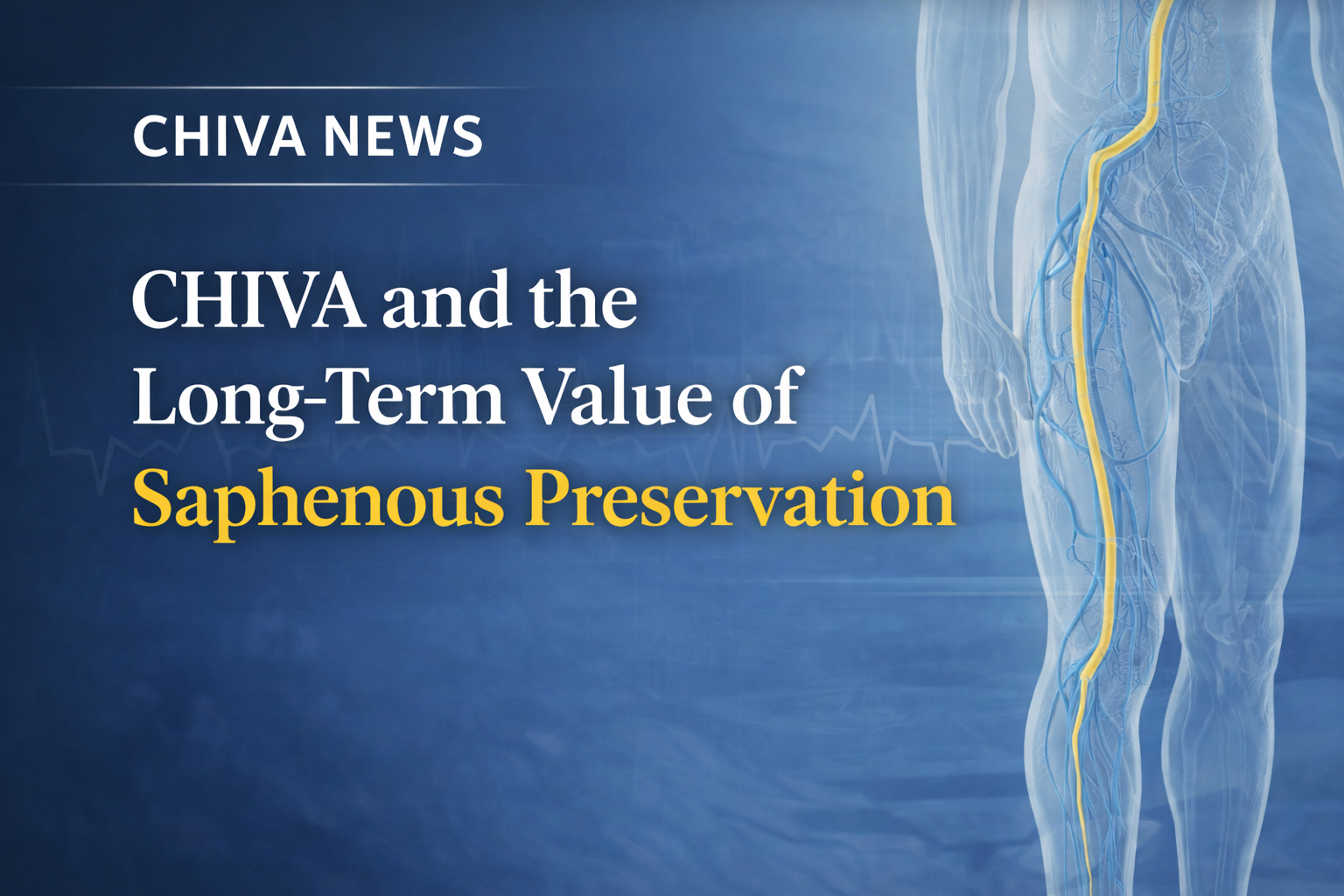
A 2025 Review Offers a Longer-Term Perspective: The Value of Preserving the Great Saphenous Vein in CHIVA Goes Beyond Being Minimally Invasive
Key Points
-
Study basis: In 2025, Hidayet Tarik Kiziltan, Stefano Ermini, and Claude Franceschi published a review in the Turkish Journal of Vascular Surgery titled CHIVA in the light of long-term studies and awareness of saphenous preservation.
-
Core perspective: The article suggests that long-term studies indicate that, after CHIVA, a dilated great saphenous vein may gradually recover toward a more normal size and function.
-
Clinical focus: The review also emphasizes that preserving the great saphenous vein is not simply about “doing less damage.” It may also matter for future bypass graft availability and for rethinking the current trend of excessive ablation.
In the treatment of varicose veins, many people understand “minimally invasive” mainly in terms of less trauma and faster recovery.
But when the time horizon becomes longer, different questions begin to matter. What happens to the vein after treatment? Can it recover function? If the patient later needs an arterial bypass, will that great saphenous vein still be available?
This 2025 review addresses exactly this level of the discussion. Rather than focusing on abstract questions such as whether CHIVA is “more advanced,” the authors shift attention to long-term follow-up and to the importance of preserving the great saphenous vein.
What the article ultimately brings into view is that the value of CHIVA may not lie only in treating the current varicose condition, but also in preserving vascular resources for the future.
1. Background and Review Design
This paper is a review published in the 2025 issue of the Turkish Journal of Vascular Surgery, volume 34, issue 3. The authors are Hidayet Tarik Kiziltan, Stefano Ermini, and Claude Franceschi.
From the abstract, the starting point of the article is very clear. CHIVA is presented as a hemodynamic treatment method that preserves the great saphenous vein and can be performed in an outpatient setting. In contrast, in current varicose vein treatment, more common approaches often involve stripping or endovenous ablation of the great saphenous vein. According to the authors, this trend may be creating a larger problem: more and more patients lose a vein that could be useful in the future.
For that reason, the review does not focus on short-term procedural differences. Instead, it concentrates on two longer-term questions:
first, what long-term studies show about the condition of the great saphenous vein after CHIVA;
and second, whether vein-preservation awareness should be re-emphasized at a time when the great saphenous vein is increasingly being removed or ablated.
2. Key Clinical Messages
According to the abstract, the article’s most important messages can be understood at two levels.
The first concerns the status of the great saphenous vein during long-term follow-up.
The authors point out that several studies suggest that after CHIVA, a previously dilated great saphenous vein may gradually return toward a more physiologic size and function. In other words, preservation in CHIVA does not mean leaving a diseased vein untouched. Rather, by correcting abnormal hemodynamics, CHIVA may allow the vein to regain a more appropriate condition once pressure has been normalized.
The second concerns the long-term resource value of the great saphenous vein.
The review makes it clear that by preserving the vein itself, CHIVA may help keep it available for future use, including possible bypass grafting. At the same time, the authors note that stripping and endovenous ablation of the great saphenous vein are now being performed at high rates in varicose vein treatment, and this may be turning “loss of saphenous vein availability” into a broader public health concern.
The conclusion of the article therefore goes beyond saying that “CHIVA is also effective.” It argues that when long-term follow-up and awareness of saphenous preservation are taken seriously, CHIVA deserves to be reconsidered as an alternative to more destructive treatment approaches. The abstract also notes that, given the wide anatomical variability of varicose veins, CHIVA remains an effective alternative associated with lower recurrence.
3. Clinical Perspective: Preserving the Great Saphenous Vein Is Not Just About “Doing Less”
One of the most valuable points in this review is that it takes “preserving the great saphenous vein” out of the category of a minor technical detail and brings it back into the discussion of long-term clinical value.
Very often, vein preservation is understood as simply a gentler option, as if it only means “doing a little less” or “causing a little less damage.”
But from the perspective of this review, the issue is much larger than that. What it emphasizes is that the great saphenous vein is not only an object of current varicose vein treatment; it is also an important autologous resource that the patient may need in the future.
This adds another layer to the meaning of CHIVA. It does not only focus on today’s reflux and pressure problems. It also extends the physician’s view further along the patient’s timeline. Will today’s treatment choice affect tomorrow’s vascular options? Could a vein that is “routinely ablated” today become a missing resource later? These are the kinds of longer-term questions this review brings back into the discussion.
Reference
Kiziltan HT, Ermini S, Franceschi C. CHIVA in the light of long-term studies and awareness of saphenous preservation. Turkish Journal of Vascular Surgery. 2025;34(3):261–268. doi:10.9739/tjvs.2025.02.016.
Note
This article is based on publicly available literature and is intended for professional communication and content reference only. It does not constitute specific medical advice.