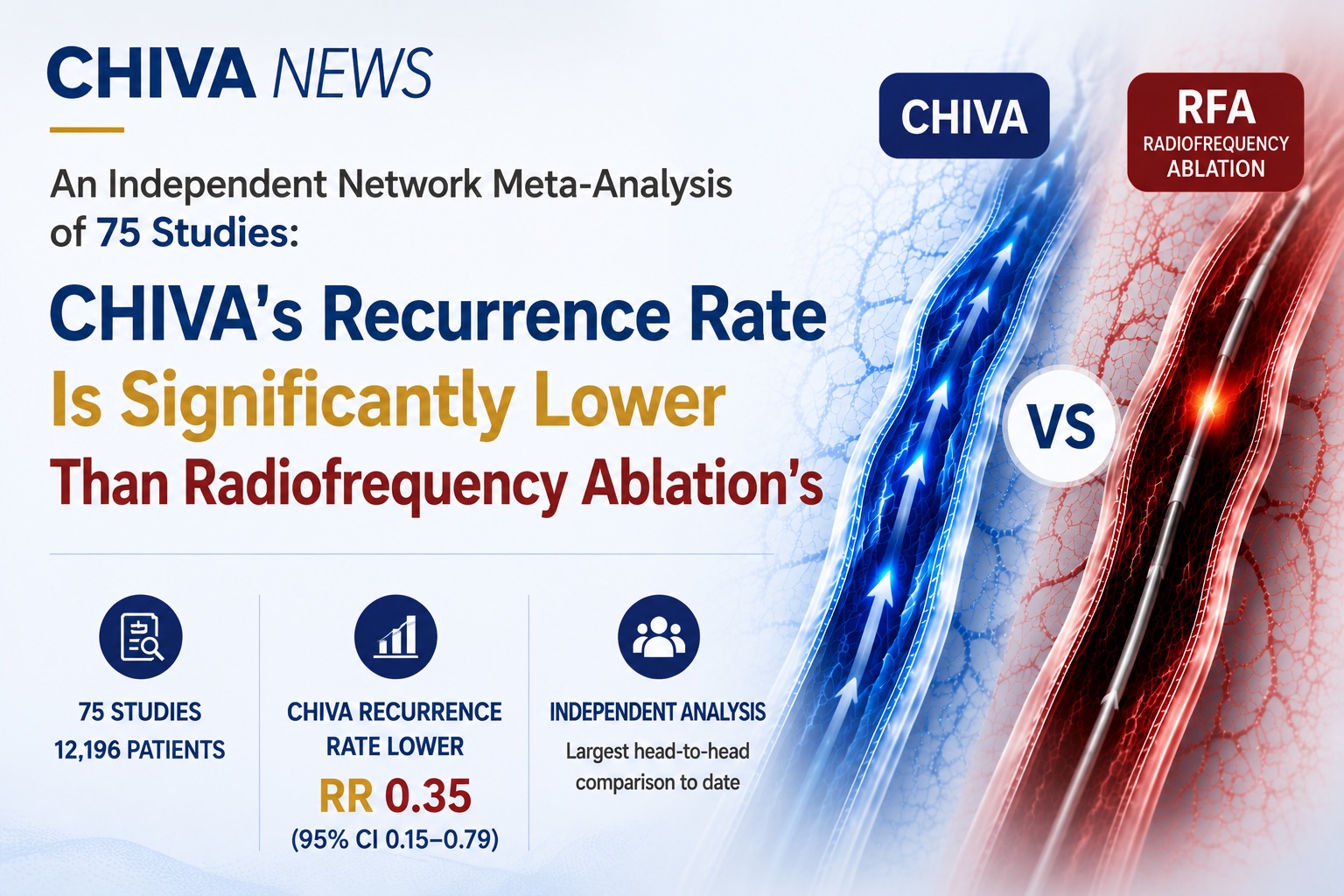
An Independent Network Meta-Analysis of 75 Studies: CHIVA’s Recurrence Rate Is Significantly Lower Than Radiofrequency Ablation’s
Key Takeaways
• Study basis: In 2024, a team at King Abdulaziz University in Saudi Arabia published a systematic review and network meta-analysis in Vascular, including 75 studies and 12,196 patients, comparing the range of endovenous and surgical treatments for great saphenous vein insufficiency.
• Core point: In this independent analysis spanning many mainstream procedures, CHIVA’s recurrence rate was significantly lower than that of radiofrequency ablation (RR 0.35, 95% CI 0.15–0.79) — on the single outcome that matters most, recurrence, the vein-sparing pathway delivered a clearly favorable result.
• Clinical relevance: This conclusion comes from a team with no ties to CHIVA, in one of the largest head-to-head comparisons to date; different procedures each have their strengths on pain and quality of life, while on recurrence, CHIVA is out in front.
In varicose vein treatment, recurrence is the core measure of whether a procedure truly solves the problem. This independent analysis from Saudi Arabia placed the major procedures into a single network and compared them — and on recurrence, the result pointed to CHIVA.
1. CHIVA is significantly better on recurrence
This network meta-analysis included 75 studies and 12,196 patients, comparing endovenous laser, radiofrequency, mechanochemical and steam ablation, foam sclerotherapy, stripping, and CHIVA across technical success, recurrence, and post-operative outcomes.
The most notable single result: CHIVA’s recurrence rate was significantly lower than radiofrequency ablation’s, with a risk ratio of 0.35 (95% CI 0.15–0.79). RFA is itself among the most well-regarded endovenous procedures for efficacy — the analysis also found it superior to stripping and to mechanochemical ablation in preventing recurrence; yet in the comparison with CHIVA, it was CHIVA that came out ahead. In other words, in a comparison network made up of today’s mainstream procedures, the one that drove recurrence lowest was this vein-sparing, flow-correcting pathway.
2. Coming from an independent third party is what gives this weight
The persuasive force of this result also comes from its source.
The analysis is from a Saudi team with no ties to CHIVA, published in a vascular surgery journal, with a sample size (12,196 patients) among the largest of any such head-to-head comparison. It is not a self-report by CHIVA’s proponents, but an independent study, from a neutral standpoint, that brought all the procedures into one evaluation — and within that framework, CHIVA still won on the core outcome of recurrence.
To be objective: the analysis did not show any one procedure leading on every dimension — steam ablation stood out for reducing post-operative pain, and mechanochemical ablation for improving quality of life and speeding recovery; the authors also note that the included studies carried an overall risk of bias, with some industry-funded. These place the conclusion within the current state of the evidence. Even so, on recurrence — the endpoint patients and clinicians weigh most — CHIVA’s advantage is clear.
3. Clinical perspective: the pathway that drove recurrence lowest
That different procedures each have their strengths shows that venous treatment is no longer a single standard, but a multi-pathway choice shaped by patient needs. And when the focus falls on lasting freedom from recurrence, the answer this independent analysis gives points to the strategy that preserves and corrects the flow.
This echoes the direction of several recent head-to-head comparisons: in long-term evaluations spanning multiple modern procedures, the vein-sparing pathway repeatedly ranks among the best on recurrence. For a method once regarded as niche, to hold a stable advantage on the most central endpoint in an independent, large-sample, multi-procedure comparison is no longer merely a claim of principle. On recurrence, the question is shifting: it is less whether CHIVA can stand alongside the mainstream procedures, and more how the others are to catch up with it.
⸻
References: Juhani AA, Abdullah A, Alyaseen EM, Dobel AA, Albashri JS, Alalmaei OM, et al. Interventions for great saphenous vein insufficiency: A systematic review and network meta-analysis. Vascular. 2025;33(5):983–998. doi:10.1177/17085381241273098.
About the authors: This study was conducted by Abdulkreem AA Juhani and colleagues at the Faculty of Medicine and King Abdulaziz University Hospital, Jeddah, Saudi Arabia, and published in Vascular.
Disclaimer: This article is compiled from publicly available literature for the purpose of professional information exchange and content research. It does not constitute specific diagnostic or treatment advice.
About CHIVA News: This column is produced by GCM (Global CHIVA Management). We are dedicated to tracking and sharing the latest academic developments, literature analyses, and clinical-practice discussions in the field of hemodynamic treatment of lower-limb venous disease worldwide, providing rigorous and objective medical information for clinical professionals.