Bringing the Vein Closer to the Skin with Ultrasound: A Technical Refinement That Makes CHIVA Incisions Smaller for Obese Patients
Key Takeaways
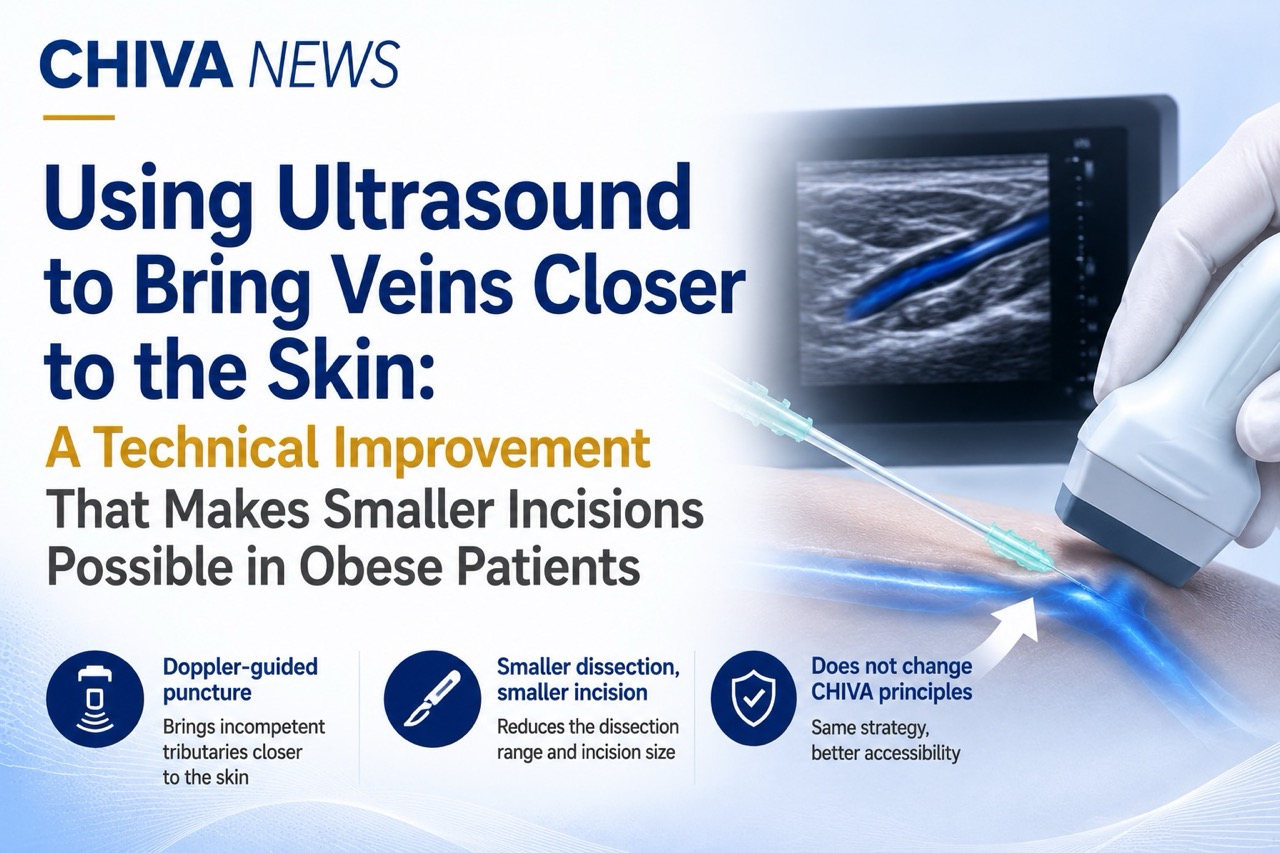
• Study basis: In 2024, Faccini and Grill of Brazil published a technical report in the Jornal Vascular Brasileiro describing a method that uses duplex-ultrasound-guided puncture to reduce the incision required for tributary ligation in CHIVA.
• Core point: By using ultrasound-guided puncture to bring the tributary closer to the skin, the extent of dissection and the size of the incision can be reduced; the authors state explicitly that this refinement does not change any of the principles of CHIVA.
• Clinical relevance: It addresses a specific, practical difficulty in performing CHIVA — the dissection required in obese patients and in thigh ligations often exceeds what is desirable; the authors also note that its long-term results are not yet known and are expected to be similar to those of standard CHIVA.
At the level of principle, CHIVA has been discussed thoroughly: spare the vein, correct the flow, decide according to the shunt type. But what often determines how workable an operation is lies in the operative details beneath those principles. This technical report from Brazil addresses exactly one such detail.
1. The specific problem it addresses
CHIVA requires flush ligation of the incompetent tributary. In most patients this is not difficult; but in some situations — the authors point specifically to obese patients and to ligations in the thigh — the vein lies deeper, and exposing it enough to ligate requires more dissection and a larger incision than is ideal.
This is not a matter of principle but of execution: the same hemodynamic decision, applied across different body types and different locations, does not carry the same operative cost.
2. The method: bringing the vein to a shallower position
The approach the authors propose is to use duplex-ultrasound-guided puncture to draw the target tributary to a position closer to the skin, and then ligate it. Once the vein is brought closer, less tissue needs to be dissected and the incision becomes smaller.
The authors are clear about the limits of this refinement: it changes none of the principles of CHIVA — the site of ligation and the shunt-type-based strategy remain the same as in standard CHIVA; only the way the vein is reached changes. They also note that the long-term results of the technique are not yet known, though expected to be similar to standard CHIVA. In other words, this is a report at the level of technique, not an efficacy study, and its value should be understood within that scope.
3. Clinical perspective: the payoff of minimal invasiveness lies in the details too
Placed within CHIVA’s development in recent years, this belongs to the same category of work: refining the precision of execution once the principles are settled.
This is worth dwelling on. CHIVA’s reason for being is that it does not destroy the vein — but if preserving the vein comes at the cost of a larger incision and more dissection, the point of being minimally invasive is eroded. This refinement addresses precisely that tension: it lets the vein-sparing pathway be carried out with less trauma even under more difficult anatomy, such as in obese patients. It runs in the same direction as other fine-tuning work around CHIVA in recent years, such as pre-operative prediction of how a shunt will evolve: all of it makes the same strategy executable more precisely, at a lower cost, under settled principles.
Beyond principle, whether a technique can be performed reliably by more surgeons and across a wider range of patients often turns on refinements like this one. It is in this quiet, practical work — not in any single dramatic result — that a mature strategy keeps proving itself.
⸻
References: Faccini FP, Grill MH. Ultrasound-guided mini-incision technique for CHIVA. Jornal Vascular Brasileiro. 2024;23:e20220157. doi:10.1590/1677-5449.202201572.
About the authors: This article was written by Felipe Puricelli Faccini of Clínica Pró-Safena and Instituto de Cardiologia, Porto Alegre, Brazil, and Marcelo Halfen Grill of Centro de Estudos Hiroshi Miyake, São Paulo, Brazil, and published in the Jornal Vascular Brasileiro.
Disclaimer: This article is compiled from publicly available literature for the purpose of professional information exchange and content research. It does not constitute specific diagnostic or treatment advice.
About CHIVA News: This column is produced by GCM (Global CHIVA Management). We are dedicated to tracking and sharing the latest academic developments, literature analyses, and clinical-practice discussions in the field of hemodynamic treatment of lower-limb venous disease worldwide, providing rigorous and objective medical information for clinical professionals.