When the Main Deep Venous Pathway Is Closed, the Great Saphenous Vein May Become the Last Compensatory Channel
Key Points
- Study basis: A 2026 case report published in Case Reports in Cardiology discussed the clinical significance of extensive collateral venous circulation and anatomic remodeling after chronic deep vein thrombosis.
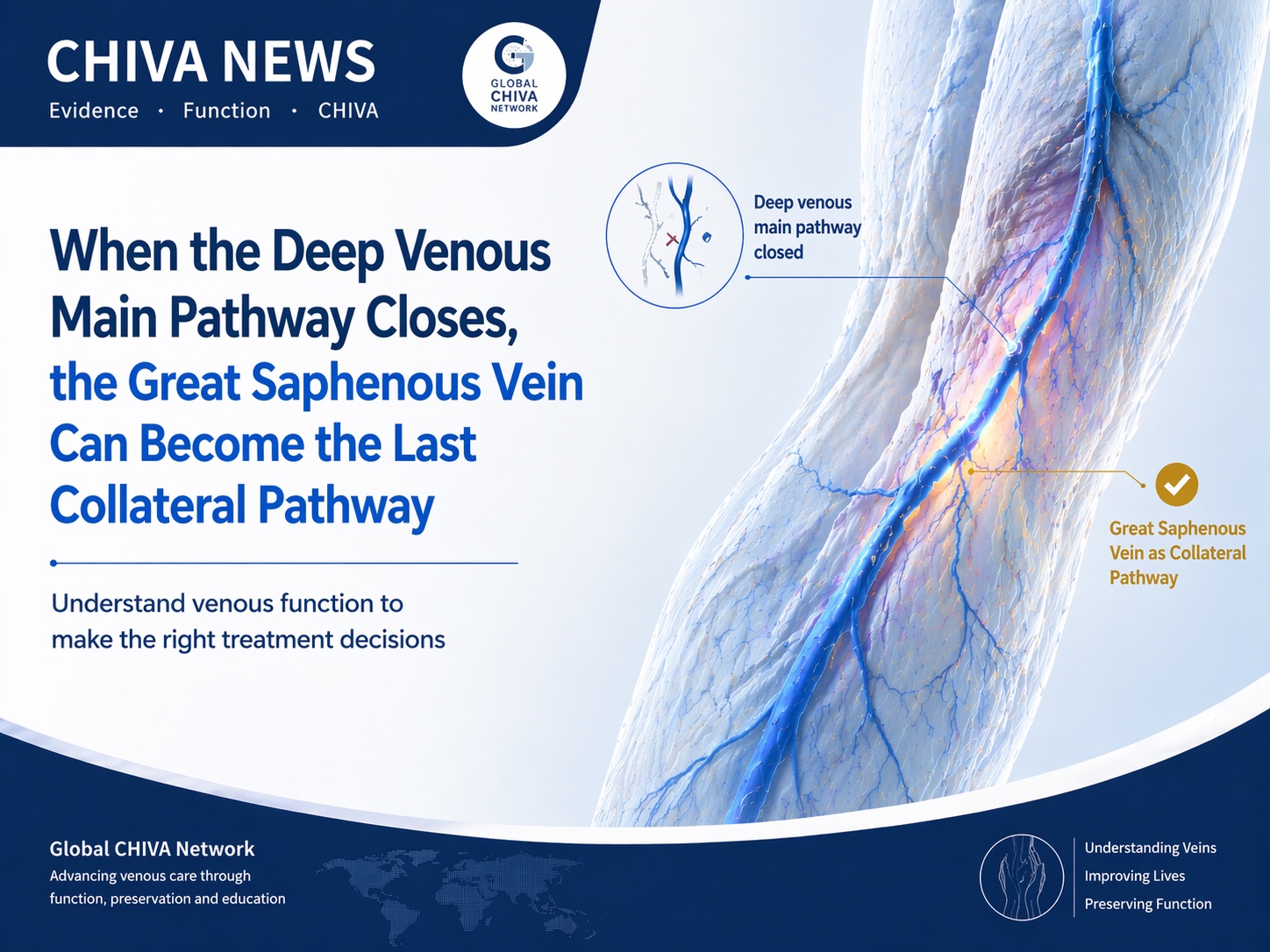
- Core finding: In this case, the ostium of the left common femoral vein was completely occluded, but venography demonstrated extensive collateral venous circulation, including a hypertrophied great saphenous vein that had become a major outflow pathway for the entire left lower extremity.
- Clinical implication: In complex venous disease, the significance of the great saphenous vein should not be judged only from the perspective of reflux. Its functional role within the overall venous return system may require renewed attention.
In many venous disorders, the great saphenous vein is often one of the first structures considered for intervention.
But once the main deep venous outflow pathway has been chronically compromised, the question is no longer only whether the vein shows reflux. It also becomes a question of whether that vein is still performing an important role within the entire venous return system.
This 2026 case report offers a very direct example of that situation. The article describes a patient with recurrent deep vein thrombosis in whom venography showed complete occlusion at the ostium of the left common femoral vein, together with extensive collateral venous circulation. Most notably, a markedly enlarged great saphenous vein was seen providing a major venous outflow pathway for the entire left lower extremity.
1. Case Background and Imaging Findings
The reported patient was a 43-year-old woman with a history of recurrent left lower-extremity deep vein thrombosis and Factor V Leiden mutation. She presented again with left leg pain and edema. Ultrasound demonstrated occlusive thrombosis in the left superficial femoral vein, and subsequent venography revealed complete occlusion at the ostium of the left common femoral vein.
What makes this case particularly informative is not simply the presence of chronic venous occlusion, but the pattern of collateral remodeling that developed in response. The authors identified extensive collateral circulation, including a markedly hypertrophied great saphenous vein. The report states that this enlarged vein was supplying the venous drainage of the entire left lower extremity.
The venographic images on page 3 make this especially clear. Figures b and d identify the enlarged left GSV, while figures c and d show newly formed collateral channels and extensive venous collateralization. This means the compensatory role of the great saphenous vein was not theoretical; it was directly visualized through imaging.
2. Functional Meaning of the Imaging Findings
The most important value of this case does not lie in repeating the general principle that chronic DVT can lead to collateral formation. Its real significance lies in showing, with direct anatomic and imaging evidence, that the great saphenous vein may at times assume a critical compensatory function.
After prolonged deep venous obstruction, the venous system may establish new pathways to preserve outflow through angiogenesis and expansion of existing channels. In this case, the great saphenous vein was no longer simply part of the superficial venous system. It had become part of a compensatory network that helped maintain venous return for the affected limb.
That is the main clinical message worth retaining from this report.
In complex venous disease, whether a vein should be treated cannot be judged only by whether it appears dilated or refluxing. It also depends on whether that vein continues to serve an essential function within the overall circulation.
3. Functional Interpretation Should Come Before Treatment Decisions
The value of cases like this lies not only in describing an unusual finding.
They also remind us that in venous disease assessment, functional interpretation may at times be more important than purely anatomic interpretation.
If one focuses only on local morphology, an abnormal-looking great saphenous vein can easily be classified as a structure that should be removed or closed. But when viewed within the full system of venous return, its role may be entirely different. In some patients, it is not merely part of the problem. It may also be part of the remaining solution.
The compensatory significance shown by imaging in this case also makes it easier to appreciate the logic emphasized by CHIVA: first understand the role of venous return, and only then decide whether intervention is necessary.
What this reflects is not simply a procedural preference, but a more fundamental clinical principle. In complex venous disease, treatment decisions should not come before a clear understanding of venous function.
4. Clinical Meaning of Conservative Management
This patient was ultimately managed conservatively, with continued anticoagulation and no additional invasive intervention. The rationale was clear: once effective collateral venous circulation had formed, further invasive procedures were considered unnecessary and potentially harmful.
The discussion also reinforces a broader principle in chronic DVT management. Lifelong anticoagulation remains central in preventing recurrent thrombotic events and pulmonary embolism, whereas more invasive interventions such as thrombectomy, thrombolysis, stenting, or bypass have a limited role in chronic disease. When thrombus has already undergone fibrotic remodeling and a stable collateral network has formed, invasive treatment may not offer additional benefit and may instead increase risk.
This is what gives the case meaning beyond a single patient.
It reminds clinicians that in complex venous disease, more intervention is not always better intervention. At times, the most important step is not to do more, but to understand what the existing venous pathways are already doing before deciding whether anything further should be done.
⸻
Reference:
Curbelo D, Lancaster I, Yaylayan A, Krolick M. Extensive Collateral Venous Circulation and Anatomic Remodeling in Chronic Deep Vein Thrombosis. Case Reports in Cardiology. 2026;Article ID 8841986.
Note:
This article is based on publicly available literature and is intended for professional communication and content reference only. It does not constitute specific medical advice.