When CHIVA Enters Chinese: The Global Challenge of Standardizing Medical Terminology
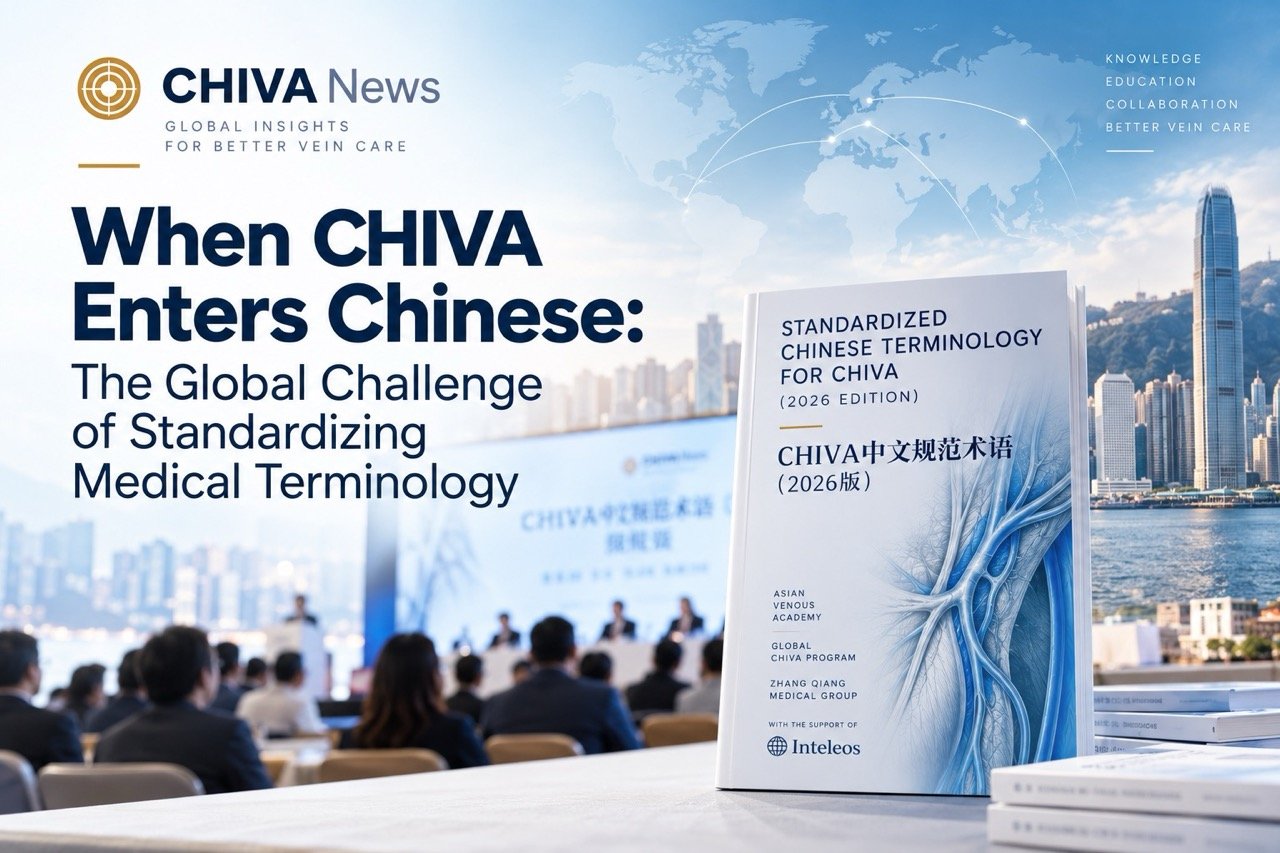
The Standardized Chinese Terminology for CHIVA (2026 Edition) has been officially released in Hong Kong. As CHIVA continues to spread across countries and languages, this initiative goes beyond terminology standardization. It raises a more fundamental question: how can a clinical approach preserve its core concepts when expressed in another language?
On September 19, 2026, the Standardized Chinese Terminology for CHIVA (2026 Edition) was officially released in Hong Kong, China.
The initiative was led by the Asian Venous Academy (AVA), with the Global CHIVA Program and Zhang Qiang Medical Group jointly organizing its development. It also received international collaborative support and joint-release support from Inteleos, an international organization specializing in medical education and certification.
Professor Claude Franceschi, the founder of CHIVA and a French expert in venous hemodynamics, participated in the review and discussion of the terminology, together with several members of the Asian Venous Academy’s Academic Advisory Committee.
During the launch event, Ma Bei, Global Strategic Advisor to the Global CHIVA Program, delivered a video address.
Dr. Du Xin, a member of the Chinese CHIVA Terminology Working Group, a member of the AVA Academic Advisory Committee, and Director of the Beijing Varicose Vein CHIVA Center at Zhang Qiang Medical Group, introduced the background and guiding principles of the terminology development.
Dr. Deng Jianping, a member of the Global CHIVA Program Expert Panel and a CHIVA Training Instructor at the Asian Venous Academy, presented explanations of selected terms on behalf of the working group.
For CHIVA, the significance of this initiative extends well beyond translating English medical terms into Chinese.
The more fundamental challenge is ensuring that a clinical approach built upon a specific hemodynamic framework retains its conceptual integrity when introduced into a different linguistic environment.
01. Why Some Terms Cannot Simply Be Translated Literally
CHIVA has developed a relatively comprehensive terminology system grounded in venous hemodynamics.
Many of its core terms do not refer merely to individual anatomical structures. Instead, they describe a segment of blood flow, a connection point, or the functional role of a vein within the broader venous drainage network.
Reflux and deflux provide a useful example.
In conventional venous ultrasound practice, reverse blood flow is generally regarded as an indication of abnormality.
Within the CHIVA framework, however, flow direction alone is not sufficient to determine its functional significance.
After CHIVA treatment, some preserved veins may continue to exhibit reverse flow. If the original pathological pressure source and abnormal hemodynamic load have been corrected, that flow may still contribute to effective venous drainage.
The same direction of blood flow can therefore have different meanings under different hemodynamic conditions.
Similarly, a re-entry point (RP) is not simply synonymous with a particular anatomically normal perforating vein.
It primarily describes a functional relationship: a point or pathway through which blood from an abnormal shunt re-enters an effective physiological drainage route.
Mapping is also more than an anatomical chart of the venous system.
In CHIVA, it involves assessing flow direction, provocative conditions, pressure sources, venous network levels, and the relationships among escape points (EPs), re-entry points (RPs), and shunts.
These examples demonstrate why terminology cannot be standardized through literal translation alone.
The accuracy of a Chinese term ultimately depends on whether it preserves the conceptual boundaries and functional meaning of the original term.
According to Dr. Du Xin, the terminology working group followed a clear guiding principle:
Conceptual equivalence comes first, followed by linguistic expression.
On this basis, the working group also considered established Chinese medical terminology and internationally accepted academic language.
02. A Shared Language Is the First Layer of Standardization
The value of standardized medical terminology extends beyond making communication easier.
For a clinical approach such as CHIVA, which relies heavily on hemodynamic assessment, inconsistent interpretations of the same term may have consequences extending to case discussions, medical education, and even treatment strategies.
In training, a stable terminology system can reduce the need for learners to repeatedly reinterpret concepts across different textbooks, instructors, and translated materials.
In international communication, establishing consistent relationships between local-language terminology and original concepts also helps physicians from different linguistic backgrounds work within a shared professional framework when discussing cases, conducting research, and participating in education.
This objective aligns with the recent development of global training and competency standards for CHIVA.
Dr. Zhang Qiang, founder of Zhang Qiang Medical Group and a vascular surgeon, recently addressed this issue in discussions concerning the global CHIVA center certification system.
He emphasized that the international development of a medical innovation should not be measured solely by how many physicians have heard of it or how many institutions have begun using its name.
More importantly, it requires the gradual establishment of a shared professional language, competency standards, and a quality assurance system.
From this perspective, terminology standardization is not the endpoint of standardization. It is the starting point.
At the launch event, Ma Bei, Global Strategic Advisor to the Global CHIVA Program, announced that the Standardized Chinese Terminology for CHIVA (2026 Edition) would be incorporated into future training modules at different levels within the Global CHIVA Program.
The aim is to help learners develop a consistent understanding of fundamental concepts and establish a common conceptual framework.
This marks an important transition: terminology is moving beyond a written language standard and becoming part of the practical educational system.
A shared language, of course, cannot replace clinical competence.
However, without a common conceptual foundation, competency assessment, tiered training, and quality control may struggle to operate according to consistent professional standards.
03. Defining the Name Also Means Defining the Method
Terminology standardization also addresses another practical question:
What can legitimately be called CHIVA?
As CHIVA spreads across more regions, its name is sometimes used to describe different combinations of treatments.
For example, procedures involving radiofrequency ablation, laser treatment, or other vein-closure techniques combined with local ligation may incorporate the term “CHIVA” into their names.
This is not a question of whether one treatment method is superior to another.
Radiofrequency ablation, laser treatment, conventional surgery, and CHIVA each have their own treatment rationale and clinical applications.
The essential issue is whether the treatment being performed is accurately described.
If “CHIVA” gradually becomes a generic label that can be attached to different treatment technologies, the specific hemodynamic strategy originally represented by the term may become increasingly unclear.
And when a name no longer consistently refers to the same clinical method, the comparability of its training standards, clinical outcomes, and research evidence may also be compromised.
Standardizing terminology is therefore not only about achieving consistency in language. It is also about preserving the conceptual boundaries of a clinical method.
04. A Challenge Likely to Reappear Across Languages
The immediate purpose of this initiative is to address terminology challenges within the Chinese-speaking medical community.
But the underlying issue is not unique to Chinese.
As CHIVA enters more countries and regions, each new linguistic environment may encounter similar questions:
Which concepts can be translated directly?
Which terms should retain their original expressions?
Could established terminology and conventions in venous surgery or vascular ultrasound alter the intended meaning of newly introduced concepts?
And how can conceptual consistency be maintained across different languages over time?
Seen from this perspective, the significance of the Standardized Chinese Terminology for CHIVA (2026 Edition) extends beyond establishing a standardized set of Chinese terms.
More importantly, it offers an approach to terminology development:
Establish conceptual clarity before choosing words. Ensure consistency in professional meaning before adapting terminology to a local language.
As global CHIVA training, case discussions, research collaboration, and competency standards continue to develop, similar challenges in language standardization may emerge in other regions and linguistic communities.
The Chinese initiative therefore provides an early practical example.
The global dissemination of a clinical method is not simply about bringing its techniques to more countries.
It also requires ensuring that the method continues to be understood consistently as it crosses linguistic boundaries.
Languages may change. Concepts must not drift.
For any clinical approach undergoing international expansion, this may be a more fundamental challenge than translation itself.
Disclaimer
This article is intended for professional information exchange and educational purposes. It does not constitute medical advice or recommendations for individual patient care.