Median 5-Year Follow-up: Groin Recurrence 7.4% vs. 1.1% Should SFJ Tributaries Be Ligated During High Ligation?
Key Takeaways
Study background:
In 2018, Cappelli, Molino-Lova, Giangrandi, Ermini and Gianesini published a comparative observational study in the Journal of Vascular Surgery: Venous and Lymphatic Disorders. The study included 867 limbs with great saphenous vein reflux. All underwent high ligation, while the main technical distinction between the two groups was whether the saphenofemoral junction (SFJ) tributaries were all ligated or preserved. Median follow-up was 5 years, with an interquartile range of 3 to 8 years.
Key finding:
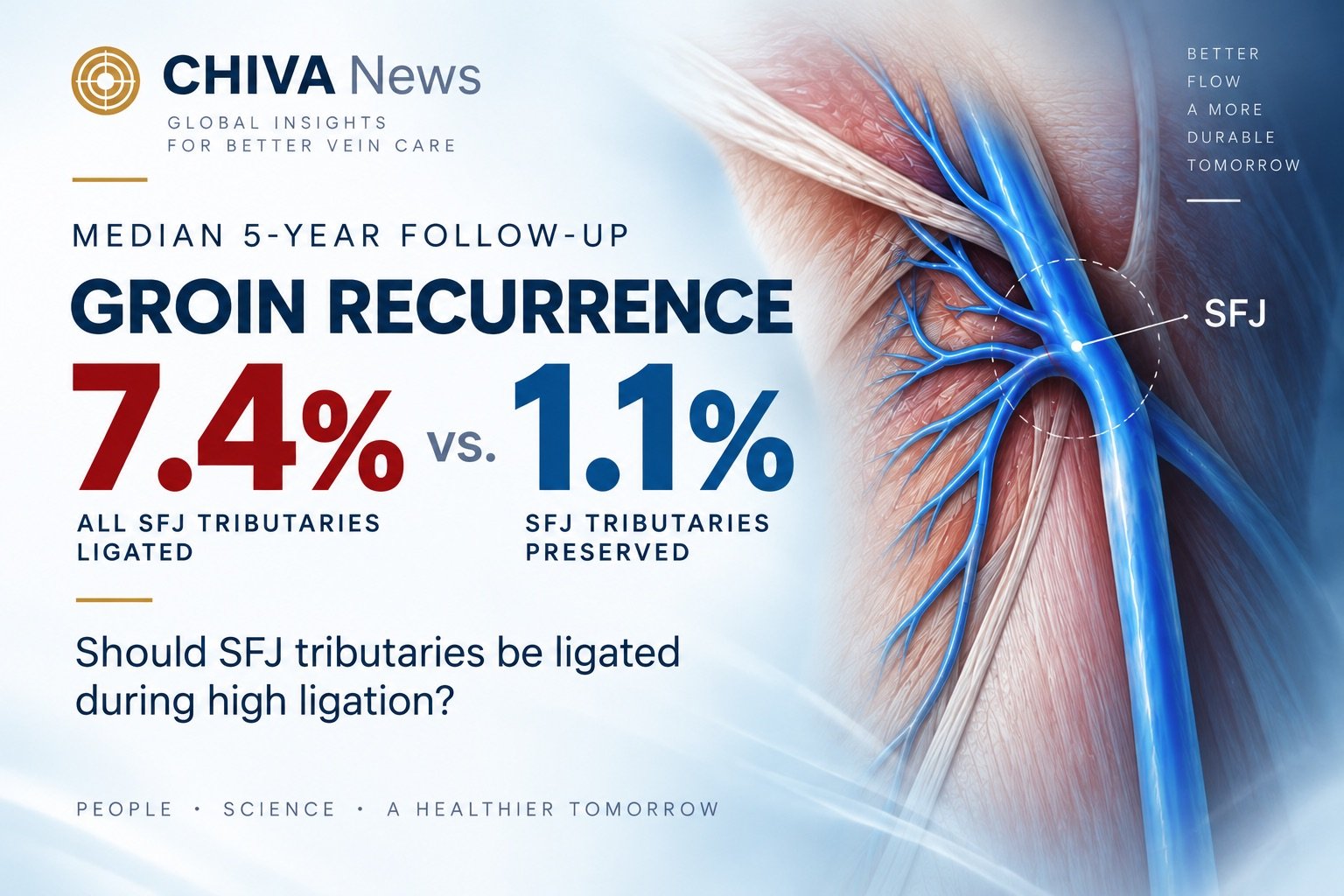
Groin recurrence was observed in 7.4% of limbs in which all SFJ tributaries were ligated, compared with 1.1% when the tributaries were preserved, with an odds ratio of 7.52 (P<0.001).
Clinical perspective:
The difference was not limited to how often recurrence occurred. The pattern of recurrence also differed: direct stump reconnection and newly developed pelvic shunts were more frequently observed when the SFJ tributaries had been ligated.
In varicose vein surgery, “more complete” treatment can easily sound more definitive.
Once abnormal reflux has already been interrupted at the SFJ level, ligating the nearby tributaries as well may appear to further reduce the opportunity for future groin recurrence.
This study tested that assumption.
1. The Same Surgical Framework, One Important Technical Choice
The study included 867 limbs with great saphenous vein reflux requiring high ligation.
Both groups underwent high ligation. The main technical distinction was how the SFJ tributaries were managed: in one group, all tributaries were ligated; in the other, they were preserved.
Recurrence was assessed by duplex ultrasound, with a median follow-up of 5 years.
The result was striking:
All SFJ tributaries ligated: 7.4% groin recurrence
SFJ tributaries preserved: 1.1% groin recurrence
The odds ratio was 7.52 (P<0.001).
Importantly, this was not a comparison between CHIVA and another treatment technique.
It was a comparison within the same general high-ligation surgical setting, focused on one specific technical decision.
That is precisely what makes the observation interesting.
2. Not Only How Often Recurrence Occurred, but How It Occurred
The most informative part of the study may not be the overall recurrence numbers.
It is the recurrence pattern.
Among limbs in which all SFJ tributaries had been ligated:
Direct stump reconnection occurred in 3.7%, compared with 0.2% in the preservation group.
Newly developed pelvic shunts occurred in 3.0%, compared with 0.5% in the preservation group.
Both differences were statistically significant (P<0.001).
These findings raise a more interesting question than recurrence alone:
Why would new flow pathways appear more often in the group in which the original junctional tributaries had been removed more completely?
3. A Possible Hemodynamic Interpretation
The study itself demonstrates an association.
Ligation of all SFJ tributaries was associated with more groin recurrence, more direct stump reconnection and more newly developed pelvic shunts.
Why this occurred is a separate question.
One possible hemodynamic interpretation is that SFJ tributaries are not simply potential routes of reflux. They may also contribute to venous drainage.
If abnormal reflux is interrupted at the SFJ while all existing tributary pathways are simultaneously closed, venous return that previously used those pathways may need to reorganize through alternative routes.
The greater frequency of stump reconnection and newly developed pelvic shunts in the ligation group is compatible with such an interpretation.
But the distinction between observation and mechanism is important:
the study shows an association between tributary management and recurrence patterns; it does not prove that closing the tributaries directly caused new shunts to form.
The hemodynamic mechanism still requires further validation.
4. This Is Not a CHIVA-vs.-Other-Treatment Study
That distinction matters.
The paper does not ask whether CHIVA is better than stripping, thermal ablation or another intervention.
Its question is much more specific:
Once high ligation has already been chosen, do all SFJ tributaries also need to be ligated?
In this observational cohort, the group treated more “completely” at the junction did not experience less groin recurrence.
The opposite was observed.
This challenges a familiar surgical intuition:
more anatomical elimination does not necessarily translate into a better long-term result.
A vein connected to the diseased network may not only represent a pathway to be eliminated.
It may also be contributing to drainage.
5. Why This Study Matters to Vein-Preserving Thinking
This is not a CHIVA outcome study.
Yet it approaches a central question of vein-preserving hemodynamic treatment from a completely different direction:
when abnormal reflux is treated, should functioning drainage pathways also be considered before they are removed?
An anatomy-first approach may naturally ask:
“What else can be eliminated?”
A hemodynamic approach adds another question:
What function might this pathway still be serving—and where will venous return go after it is closed?
The study cannot answer that mechanism directly.
But it provides an intriguing clinical observation: under the same high-ligation setting, preserving SFJ tributaries was associated with less groin recurrence, while ligating them all was associated with more stump reconnection and newly developed pelvic shunts.
What makes this especially interesting is that the study was not designed to prove CHIVA.
6. Evidence Boundary
This was a comparative observational study, not a randomized controlled trial.
The large cohort and relatively long follow-up make the findings clinically valuable, but unmeasured differences between the groups may still have influenced the results.
The observed 7.4% versus 1.1% difference therefore supports a strong association.
It does not, by itself, prove that ligating SFJ tributaries causes more groin recurrence.
The broader question remains one for higher-level evidence.
From “What Else Should We Remove?” to “What Should We Preserve?”
Venous surgery often focuses on one question:
What else needs to be treated?
This study points toward another:
What may still be worth preserving?
At a median follow-up of 5 years, groin recurrence was 7.4% when all SFJ tributaries were ligated and 1.1% when they were preserved.
More importantly, the additional recurrences were characterized by direct stump reconnection and newly developed pelvic shunts.
These observations do not establish why the venous network reorganized in this way.
But they do support an important principle:
closing a venous pathway does not mean that the venous return previously using that pathway simply disappears.
The more relevant question may be whether abnormal flow can be interrupted while effective drainage pathways are still preserved.
In a connected venous network, treatment is therefore not only about deciding what to close.
It is also about understanding what still needs to remain open.
Reference
Cappelli M, Molino-Lova R, Giangrandi I, Ermini S, Gianesini S. Ligation of the saphenofemoral junction tributaries as risk factor for groin recurrence. Journal of Vascular Surgery: Venous and Lymphatic Disorders. 2018;6(2):224–229. doi:10.1016/j.jvsv.2017.09.005. PMID: 29290602.
About the Authors
This study was conducted by Massimo Cappelli and Ilaria Giangrandi in Florence, Raffaele Molino-Lova and Stefano Ermini in Grassina, and Sergio Gianesini, affiliated with the Department of Morphology, Surgery and Experimental Medicine at the University of Ferrara, Italy, and the Department of Surgery at the Uniformed Services University of the Health Sciences in Bethesda, USA. The study was published in the Journal of Vascular Surgery: Venous and Lymphatic Disorders.
Disclaimer
This article is based on published research and is intended for professional information and educational purposes only. It does not constitute medical advice.
About CHIVA News
CHIVA News is planned and produced by GCM (Global CHIVA Management). We track and share academic developments, research evidence, literature insights, and clinical practice in the hemodynamic management of lower-extremity venous disease, with the aim of providing rigorous, objective, and clinically relevant information for medical professionals.
Comments and professional discussion are welcome. We also encourage readers to share CHIVA News with colleagues who may be interested in venous hemodynamics and vein-preserving treatment strategies.