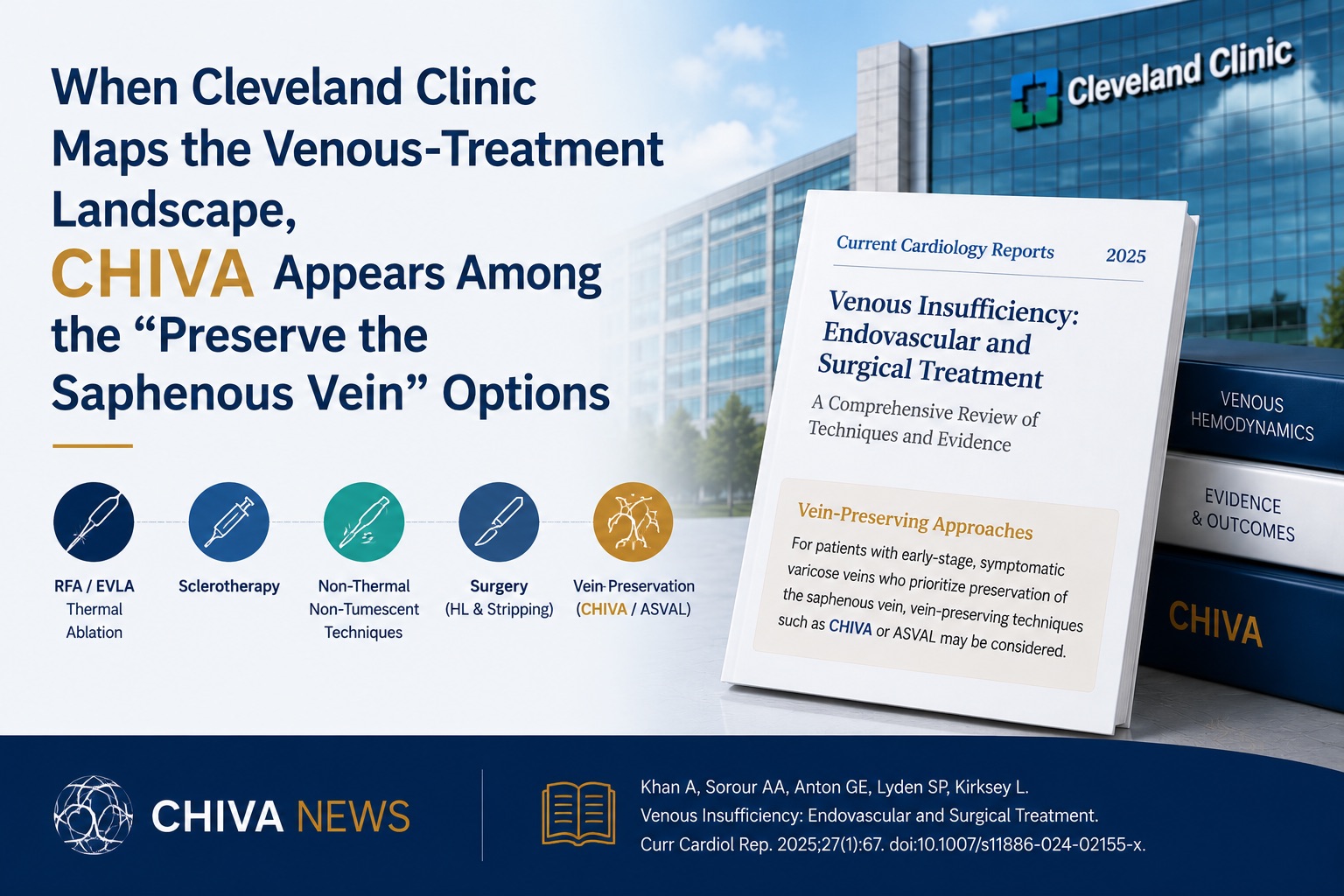
When Cleveland Clinic Maps the Venous-Treatment Landscape, CHIVA Appears Among the “Preserve the Saphenous Vein” Options
Key Takeaways
• Study basis: In 2025, a vascular surgery team at the Cleveland Clinic published a review of venous insufficiency treatment in Current Cardiology Reports, surveying the full range of options — from open surgery and endovenous ablation to vein-sparing strategies.
• Core point: Within this review, which is centered on endovenous and surgical treatment, CHIVA is listed among the techniques that may be considered for patients with early-stage symptomatic disease when preserving the saphenous vein is a priority.
• Clinical relevance: The significance is positional. CHIVA appears in a landscape review from a leading, unaffiliated institution, named alongside the mainstream procedures — no longer confined to the literature devoted specifically to it.
There is a quiet but reliable marker of whether a treatment has entered the mainstream: whether it appears, listed matter-of-factly as one option, in a “whole-landscape” review produced by an authoritative institution with no stake in it. This 2025 review from the Cleveland Clinic is one such vantage point.
1. What the review says
This is a review of venous insufficiency treatment, covering the range of endovenous and open-surgical options and discussing, for each, technique, patient selection, outcomes, and complications. Its main thread runs through today’s mainstream procedures — thermal ablation such as radiofrequency and laser, non-thermal non-tumescent techniques such as mechanochemical ablation and cyanoacrylate, sclerotherapy, and high ligation and stripping. The review also notes that current SVS and AVF guidelines recommend endovenous approaches over high ligation and stripping where the expertise is available, and that non-thermal non-tumescent techniques, while yielding lower closure rates than thermal ablation, are associated with better quality-of-life scores.
It is alongside this endovenous-centered thread that the review notes: for patients with early-stage, symptomatic varicose veins for whom preserving the saphenous vein is a priority, vein-sparing techniques such as CHIVA or ASVAL may be considered. To be clear, this is a conditional option the review offers, not a focused endorsement of any one procedure — but where it appears is precisely what is worth noticing.
2. What “being listed this way” means
The significance lies not in a ranking or an efficacy claim, but in position.
CHIVA appears in a whole-landscape review from a leading, independent academic institution, named alongside RFA, EVLA, sclerotherapy, and surgery as an option under a specific clinical priority. For a method long regarded as niche, to be folded in by an institution like this, in such a matter-of-fact tone, is itself a change in position.
And the category it is placed in — preservation of the saphenous vein — aligns with the review’s own observation that the field increasingly values minimal invasiveness and quality of life. CHIVA sits at the most preservation-oriented end of that movement. What it is listed under is not a footnote, but a direction that is being re-valued.
3. Clinical perspective: preservation as a formally listed option
The review repeatedly stresses that venous treatment is not one-size-fits-all and must be individualized to anatomy, disease severity, quality of life, and patient expectations. Within that individualized logic, when preserving the saphenous vein becomes an explicit goal, CHIVA is among the options on the table.
This is precisely where it stands on the firmest ground: not competing to remove the diseased vein most thoroughly, but answering a specific and legitimate clinical priority — offering an established pathway when the vein is to be preserved. As more landscape reviews and guidelines from mainstream institutions fold preservation-minded options into the picture, CHIVA’s place in the standard repertoire will only become clearer.
⸻
References: Khan A, Sorour AA, Anton GE, Lyden SP, Kirksey L. Venous Insufficiency: Endovascular and Surgical Treatment. Current Cardiology Reports. 2025;27(1):67. doi:10.1007/s11886-024-02155-x. PMID: 40047963.
About the authors: This study was conducted by Abdullah Khan, Ahmed A. Sorour, George E. Anton, Sean P. Lyden, and Lee Kir
Disclaimer: This article is compiled from publicly available literature for the purpose of professional information exchange and content research. It does not constitute specific diagnostic or treatment advice.
About CHIVA News: This column is produced by GCM (Global CHIVA Management). We are dedicated to tracking and sharing the latest academic developments, literature analyses, and clinical-practice discussions in the field of hemodynamic treatment of lower-limb venous disease worldwide, providing rigorous and objective medical information for clinical professionals.