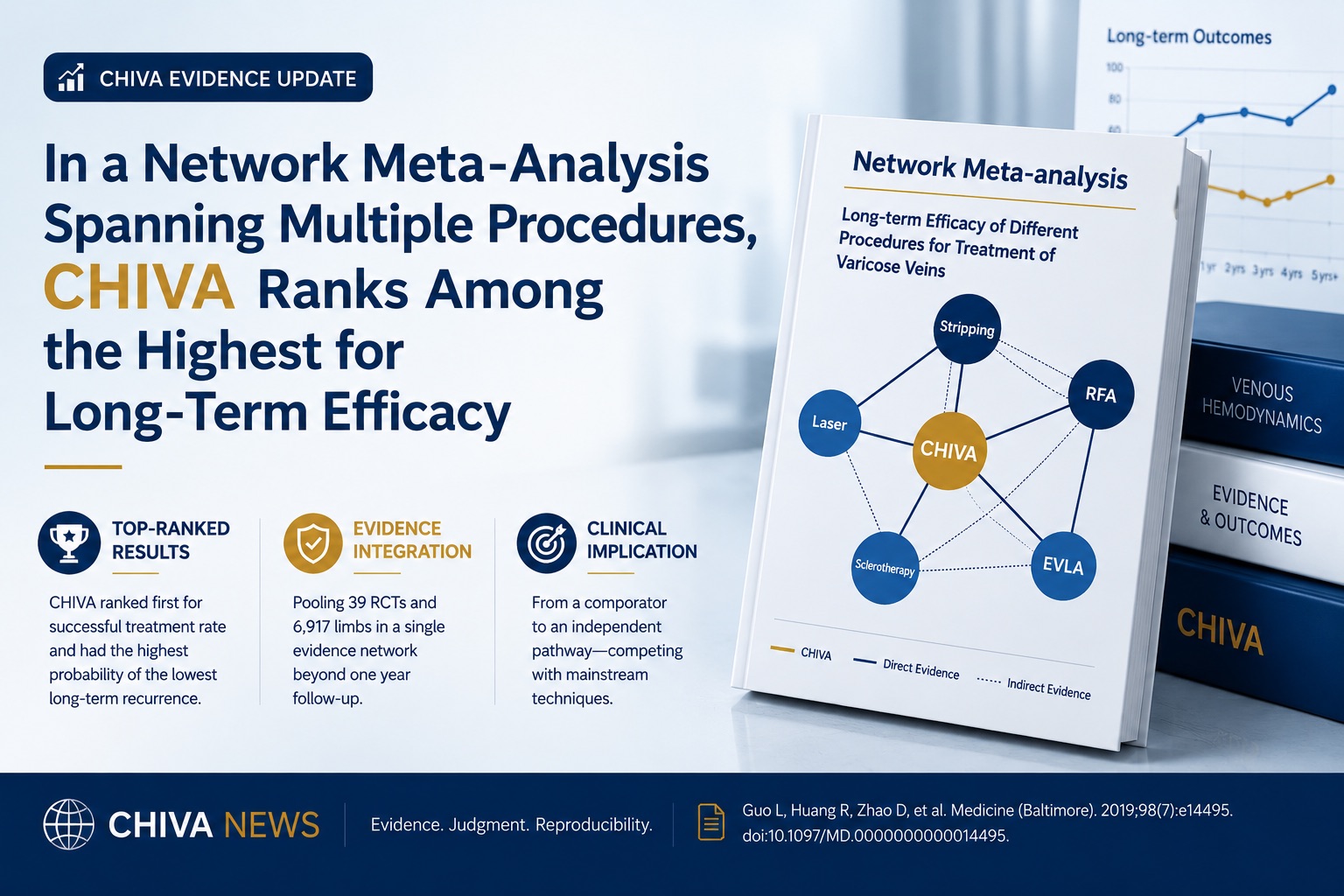
In a Network Meta-Analysis Spanning Multiple Procedures, CHIVA Ranks Among the Highest for Long-Term Efficacy
Key Takeaways
• Study basis: In 2019, Guo et al. published a network meta-analysis in Medicine (Baltimore), pooling 39 RCTs and 6,917 limbs, placing stripping, laser and radiofrequency ablation, sclerotherapy, and CHIVA within a single evidence network to compare long-term efficacy at follow-up beyond one year.
• Core point: In the study’s treatment ranking, CHIVA ranked first for successful treatment rate and had the highest probability of achieving the lowest long-term recurrence; the authors described it as having “seemed to have superior clinical benefits.”
• Clinical relevance: This study was among the earlier works to treat CHIVA as an independent pathway and place it in direct comparison with multiple modern techniques — marking a shift in its position within the venous-treatment landscape.
For a long time, comparisons in varicose vein treatment were linear: one procedure against another, with conclusions centered on “lower recurrence” or “fewer complications.” But as endovenous techniques became widespread, the choice clinicians weigh is no longer “to strip or not to strip,” but among several coexisting options — thermal ablation, sclerotherapy, stripping, and the hemodynamic, vein-sparing strategy. To judge where a method stands in this landscape, single-line comparison no longer suffices.
A network meta-analysis is built precisely for this: it connects the comparisons among many procedures into a single evidence network and, using common comparators, integrates direct and indirect evidence, so that the relative position of each procedure can be inferred even without head-to-head trials. Within CHIVA’s evidence trajectory, the work by Guo and colleagues is among the earlier efforts to lift it out of the position of a comparator to one specific procedure and place it within a multi-pathway comparison.
1. In this network, CHIVA ranks near the top
The study pooled 39 RCTs and 6,917 limbs, comparing 5 procedures and 4 combination regimens, focusing on two long-term outcomes: successful treatment rate and recurrence.
At follow-up beyond one year, CHIVA ranked highest for successful treatment rate and had the highest probability of achieving the lowest recurrence. In other words, in a network that simultaneously holds stripping, laser, radiofrequency, and sclerotherapy, the pathway sitting at the front is this one — preserving the vein and correcting the flow.
A careful distinction is needed here: a ranking gives a relative position, not a verdict that something has been “proven superior.” The authors’ own wording is measured — the original text says CHIVA “seemed to have superior clinical benefits.” Yet even read under this cautious framing, in a comparison that encompasses today’s mainstream procedures and uses long-term outcomes as its yardstick, this vein-sparing pathway still ranks among the front, which in itself carries weight.
2. Clinical perspective: from “comparator” to “independent pathway”
In earlier one-to-one studies, CHIVA usually appeared as a “challenger,” compared directly with stripping or some standard operation. In this network, it enters as an independent pathway, ranked alongside stripping, laser, radiofrequency, and sclerotherapy, and sits near the front on long-term outcomes. This means that CHIVA is no longer merely a reference point for one procedure, but an independent pathway that can be evaluated on the same tier as mainstream techniques.
More intriguing is the logic behind it. Ablation and stripping follow the approach of “removing or closing the diseased vein”; CHIVA does the opposite — preserving the trunk and correcting only the abnormal flow. Yet in a ranking centered on long-term success and recurrence, the one near the front is precisely the latter, running counter to the intuition that “the diseased vein must be removed to solve the problem.” It points instead to an easily overlooked possibility: over the long term, preserving and correcting the flow is itself a pathway that holds its ground, and may even hold an advantage.
Placed back on CHIVA’s evidence timeline, the significance of this study comes into focus. It did not appear late; it was among the earlier works to bring CHIVA into the same comparison as modern procedures and show it ranking near the front, and the evidence accumulated since has largely continued the direction it sketched. As more long-term evidence points the same way, where the “preserve and correct the flow” pathway will be placed in varicose vein treatment is, perhaps, becoming gradually clearer.
⸻
References:
Guo L, Huang R, Zhao D, Xu G, Liu H, Yang J, Guo T. Long-term efficacy of different procedures for treatment of varicose veins: A network meta-analysis. Medicine (Baltimore). 2019;98(7):e14495. doi:10.1097/MD.0000000000014495. PMID: 30762775.
About the authors:
This study was conducted by researchers from the School of Nursing, Huanggang Polytechnic College; the Institute of Digestive Surgery, Southwest Hospital, Army Medical University; Huanggang Maternal and Child Health Hospital; and the Department of Hepatobiliary and Pancreatic Surgery, Zhongnan Hospital of Wuhan University, with Tao Guo of Zhongnan Hospital of Wuhan University as corresponding author. It was published in Medicine (Baltimore).
Disclaimer:
This article is compiled from publicly available literature for the purpose of professional information exchange and content research. It does not constitute specific diagnostic or treatment advice.
About CHIVA News:
This column is produced by GCM (Global CHIVA Management). We are dedicated to tracking and sharing the latest academic developments, literature analyses, and clinical-practice discussions in the field of hemodynamic treatment of lower-limb venous disease worldwide, providing rigorous and objective medical information for clinical professionals.