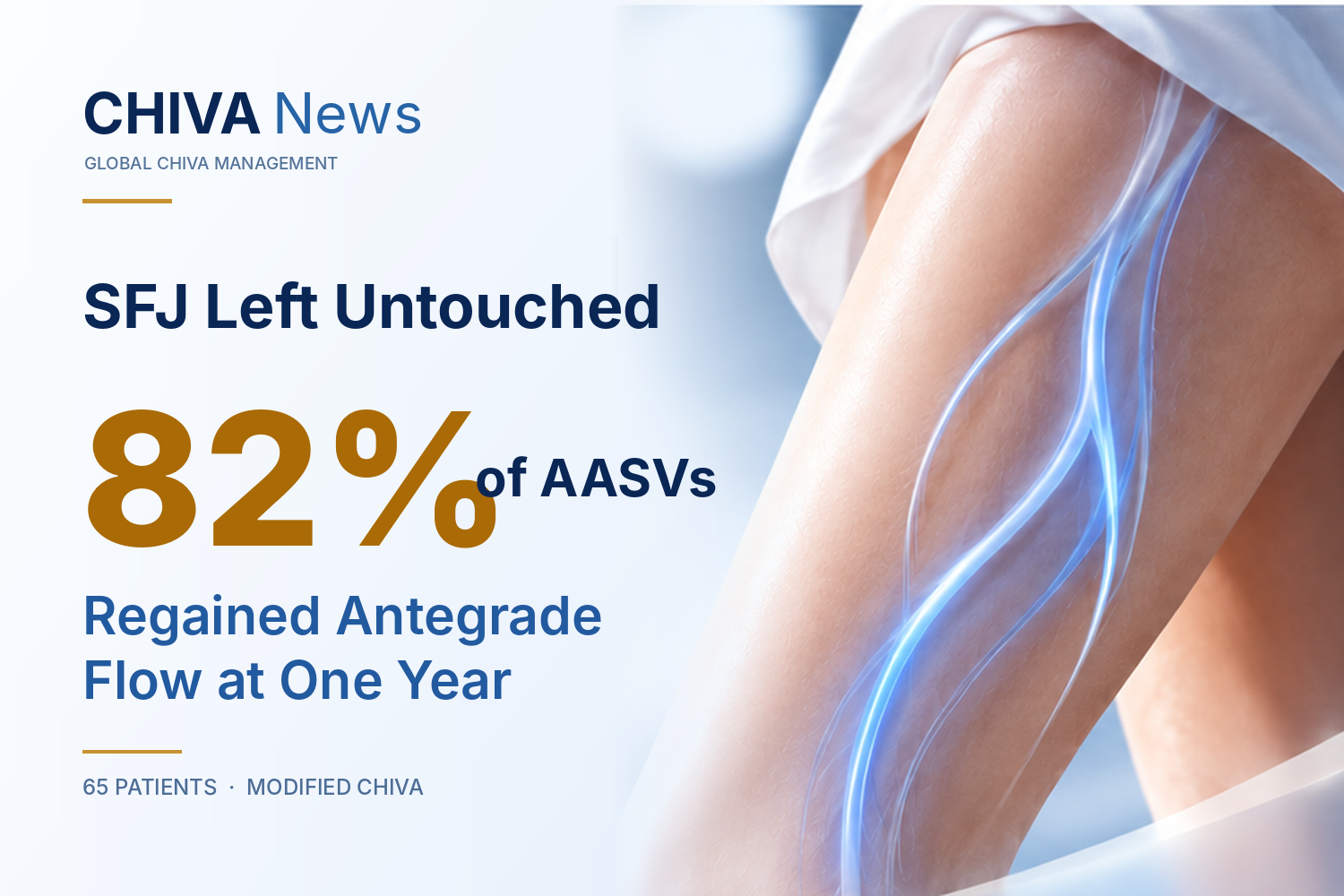
SFJ Left Untouched: 82% of Anterior Accessory Saphenous Veins Regained Antegrade Flow
Key Takeaways
Study Overview: In 2016, researchers from the University of Granada and Complejo Hospitalario de Jaén, Spain, published a prospective study in Cirugía Española. Sixty-five patients with varicose veins involving the anterior accessory saphenous vein (AASV) underwent a modified CHIVA procedure. The saphenofemoral junction (SFJ) was left untouched, and the AASV trunk was preserved. Treatment consisted of disconnecting incompetent tributaries and performing phlebectomy. Patients were followed for one year.
Key Findings: At one year, 82% of AASVs had regained antegrade flow, with mean diameter decreasing from 6.4 mm to 3.4 mm. The varicose vein recurrence rate was 8%. Meanwhile, the previously normal great saphenous vein (GSV) maintained antegrade flow, with no significant change in diameter.
Clinical Implications: Reflux in a saphenous trunk does not necessarily require direct intervention at the SFJ. Whether tributary disconnection alone is appropriate depends on comprehensive hemodynamic assessment, including the Reflux Elimination Test (RET), provocative maneuvers, valve responses, and the overall venous drainage configuration.
1. Why Can the SFJ Be Left Untouched?
Conventional surgical treatment of AASV varicosities often involves intervention at the saphenofemoral junction.
This study explored a different approach: preserving both the junction and the saphenous trunk while selectively disconnecting the tributaries involved in the abnormal venous shunt.
The key was careful preoperative patient selection.
All 65 patients had a positive Reflux Elimination Test (RET), while their original GSV maintained antegrade flow.
RET involves temporarily compressing a varicose tributary under ultrasound guidance to determine whether reflux in the AASV trunk disappears. If reflux is eliminated, the finding suggests that the tributary may contribute to maintaining the abnormal hemodynamic condition.
However, RET alone is not sufficient to determine the treatment strategy.
Clinical decision-making also requires assessment of flow changes during different provocative maneuvers, valve responses, venous network configuration, and the availability of effective drainage pathways.
A positive compression test cannot, by itself, predict long-term postoperative outcomes.
In the selected patients, the researchers performed the procedure under local anesthesia in an outpatient setting. The incompetent tributaries were disconnected from the AASV, and the varicose veins were removed through phlebectomy.
The SFJ and AASV trunk were preserved.
2. At One Year, 82% Regained Antegrade Flow
The study reported several important findings:
- Flow direction: 53 patients (82%) regained antegrade flow in the AASV, while 12 (18%) had persistent reflux.
- Vein diameter: Mean AASV diameter decreased from 6.4 mm to 3.4 mm (P<0.001).
- Clinical outcomes: The varicose vein recurrence rate was 8%. Clinical and cosmetic scores improved, with a mean patient satisfaction score of 9.4 out of 10.
- Vein preservation: The previously normal GSV maintained antegrade flow. Its mean diameter changed from 3.73 mm to 3.70 mm, without a statistically significant difference.
Regarding safety, seven patients (11%) developed asymptomatic partial AASV thrombosis. These thrombi were no longer present at the one-year follow-up. No deep vein thrombosis was observed.
These findings suggest that, in appropriately selected patients, favorable clinical and hemodynamic outcomes may be achieved without directly treating the SFJ or closing the refluxing saphenous trunk.
Instead, modifying the abnormal shunt configuration may be sufficient to restore a more favorable flow pattern.
3. Clinical Perspective: What Sustains the Reflux?
Perhaps the most important contribution of this study is not simply the 82% restoration of antegrade flow, but the treatment decision-making strategy it illustrates.
Where reflux enters the venous network and what sustains that reflux are not necessarily the same question.
When reflux in a saphenous trunk depends on an abnormal hemodynamic relationship involving specific tributaries, interrupting that relationship may change the direction of flow in the trunk without requiring direct intervention at the SFJ.
However, this does not mean that the same approach is suitable for every patient with AASV reflux.
The researchers found that an initial AASV diameter greater than 7.5 mm and excess body weight were associated with less favorable hemodynamic outcomes. The authors suggested that this strategy might not be the preferred option for such patients.
The study also had important limitations. It included only 65 patients, had no concurrent control group, and provided just one year of follow-up.
Restoration of antegrade flow at one year does not guarantee freedom from future reflux or recurrence.
The findings therefore support a treatment option worthy of further investigation, rather than establishing a universal surgical rule.
For CHIVA, this study illustrates a central principle of individualized hemodynamic management:
The presence of reflux does not automatically mean that the saphenous trunk must be closed. The first step is to understand how abnormal flow develops, what sustains it, and which physiological drainage pathways should be preserved.
In appropriately selected patients, accurate hemodynamic assessment may help avoid unnecessary interventions while preserving veins that retain functional and potential future clinical value.
Reference
Maldonado-Fernández N, Linares-Palomino JP, López-Espada C, Martínez-Gámez FJ, Ros-Díe E. Clinical results of a new strategy (modified CHIVA) for surgical treatment of anterior accessory great saphenous varicose veins. Cirugía Española (English Edition). 2016;94(3):144–150.
DOI: 10.1016/j.cireng.2016.02.020
About the Authors
This study was conducted by researchers from the Vascular Surgery Department at Complejo Hospitalario de Jaén and the Department of Surgery at the University of Granada, Spain. The first author was N. Maldonado-Fernández. The study was published in Cirugía Española.
Disclaimer
This article is based on published research and is intended for professional information and educational purposes only. It does not constitute medical advice.
About CHIVA News
CHIVA News is planned and produced by GCM (Global CHIVA Management). We track and share academic developments, research evidence, literature insights, and clinical practice in the hemodynamic management of lower-extremity venous disease, with the aim of providing rigorous, objective, and clinically relevant information for medical professionals.
Comments and professional discussion are welcome. We also encourage readers to share CHIVA News with colleagues who may be interested in venous hemodynamics and vein-preserving treatment strategies.